
Introduction
The ESEGAS LEUF-200 Ultrasonic Flow Meter is designed for continuous measurement of gas flow velocity and volumetric flow in industrial ducts, pipelines, and exhaust stacks. It uses the ultrasonic time-of-flight principle, measuring the difference in transmission time between ultrasonic pulses traveling with and against the direction of gas flow. This measurement enables the system to calculate gas velocity and flow rate without inserting moving mechanical components into the gas stream. Optional temperature and pressure sensors support additional flow compensation and process monitoring. The instrument is suitable for industrial exhaust measurement, flue gas monitoring, and CEMS integration.
Measured parameter: Gas flow rate
| Operating Principle | Ultrasonic Time-of-Flight Method |
|---|---|
| Measured Variables | Industrial exhaust gases, process gas velocity, actual volumetric flow rate |
| Measurement Range | Velocity: 0–40 m/s (Temperature measurement range: 0–300 °C) |
| Velocity Measurement Accuracy | ±0.1 m/s |
| Temperature Measurement Accuracy | ±1 °C & ±1% FS |
| Repeatability | When V > 2 m/s: ±1%; When V < 2 m/s: ±0.02 m/s |
| Touchscreen Display | Displays measurement variables |
| Measurement Distance | Through-flow: 0.5 m–15 m; Single-end: Fixed distance of 0.4m |
| Medium Temperature | Standard type: –20 °C to +150 °C; High-temperature type: –20 °C to +300 °C |
| Installation Angle | 30°–60° depending on operating conditions |
| Analog Output | 4–20 mA, 3 channels |
| 3-channel interface modes | USB 1.0, 1 x RS485 |
| Supply Voltage | 220 VAC, 50 Hz |
| Air Supply Requirements | 0.4–0.6 MPa, oil-free and water-free, pipe diameter φ8 |
| Power | 75 W / 350 W (with purge fan) |
| Ambient Temperature | –20 °C to +55 °C |
| Process Requirements | Humidity ≤35%, dust concentration under standard conditions <100 g/Nm³, vibration velocity ≤7.1 mm/s RMS |
| Functional Grounding (FE) | ≤1 Ω |
| Main Unit | 300 × 400 × 130 mm, Weight: 7.5 kg |
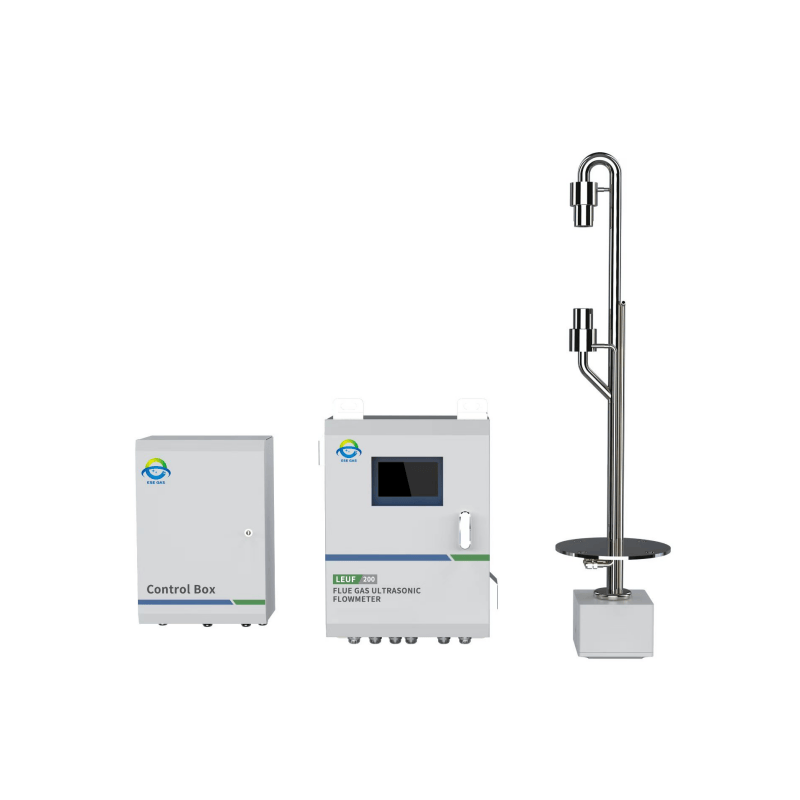
Integrating two probes, a control and calculation unit, provides a wealth of interfaces. We can expand the interface to different signal inputs and outputs, and can meet the needs of different occasions under the application.
ESEGAS Ultrasonic Flow Meter LEUF-200 for Flue Gas Application is to measure the flow rate of the gas; it can also calculate and output the volumeflow rate according to the flow rate and the flue size; if you input the temperature and pressure of the flue gas, you can calculate the flow rate under the standard conditions.
The transmit/receive probe consists of a piezoelectric ultrasonic generator and a receiver. The acoustic pulse and the direction of gas flow to form the angle α, the ultrasonic and gas flow direction counter-current and downstream transmission time is determined by the angle α and the gas flow velocity v. The larger the difference between the ultrasonic transmission time, the faster the gas flow rate, temperature and pressure fluctuations can cause the ultrasonic propagation speed changes, but in this measurement method, does not affect the calculation of the gas flow rate.
The Ultrasonic Flow Meter for Flue Gas Application measures the flow rate of gases discharged from ducts, flues, exhaust gases and flues; it can be used in both pure and raw gases; ie in closed circuits as well as in open gas circuits.
ESEGAS offers single-sided and double-sided ultrasonic flow meters for flue gas flow measurement. Available models cover duct diameters from 0.5 to 11 meters. Customers can select the appropriate configuration according to the duct diameter and installation conditions.
Yes. ESEGAS ultrasonic flow meters feature a back-purge function to help keep the measurement probes clean and reduce dust accumulation. They are designed for flue gas temperatures up to 200°C. The selected model and installation arrangement should match the actual operating conditions.
An ultrasonic flow meter measures gas flow velocity or flow rate in industrial ducts and pipelines. It is used in exhaust monitoring, process control, and Continuous Emission Monitoring Systems.
A transit-time ultrasonic flow meter sends sound pulses in and against the direction of gas flow. It calculates flow velocity by measuring the difference in ultrasonic transmission times.
Yes. Industrial ultrasonic flow meters from ESEGAS have optional function which can be add temperature and pressure optional functions except flue gas flow rate.
CEMS combines pollutant concentration measurements with flue gas flow measurements to calculate pollutant mass emissions. Accurate flow data is therefore important for emission reporting.
Ultrasonic meters determine flow using acoustic signals, while differential pressure meters calculate flow from pressure differences across a flow restriction or pressure-sensing arrangement.
Typical applications include power plant stacks, industrial boilers, cement kilns, waste incinerators, and industrial exhaust ducts. ESEGAS also identifies flow measurement as an important input for calculating pollutant mass emissions in CEMS.
The Ultrasonic Flow Meter performs gas flow rate measurements by measuring the lag time of ultrasonic pulses. Meanwhile, we mount the transmitter/receiver probe on the side of the stack. And we orient the transmitter/receiver probe at a certain angle to the direction of gas flow.
| Operating Principle | Ultrasonic Time-of-Flight Method |
|---|---|
| Measured Variables | Industrial exhaust gases, process gas velocity, actual volumetric flow rate |
| Measurement Range | Velocity: 0–40 m/s (Temperature measurement range: 0–300 °C) |
| Velocity Measurement Accuracy | ±0.1 m/s |
| Temperature Measurement Accuracy | ±1 °C & ±1% FS |
| Repeatability | When V > 2 m/s: ±1%; When V < 2 m/s: ±0.02 m/s |
| Touchscreen Display | Displays measurement variables |
| Measurement Distance | Through-flow: 0.5 m–15 m; Single-end: Fixed distance of 0.4m |
| Medium Temperature | Standard type: –20 °C to +150 °C; High-temperature type: –20 °C to +300 °C |
| Installation Angle | 30°–60° depending on operating conditions |
| Analog Output | 4–20 mA, 3 channels |
| 3-channel interface modes | USB 1.0, 1 x RS485 |
| Supply Voltage | 220 VAC, 50 Hz |
| Air Supply Requirements | 0.4–0.6 MPa, oil-free and water-free, pipe diameter φ8 |
| Power | 75 W / 350 W (with purge fan) |
| Ambient Temperature | –20 °C to +55 °C |
| Process Requirements | Humidity ≤35%, dust concentration under standard conditions <100 g/Nm³, vibration velocity ≤7.1 mm/s RMS |
| Functional Grounding (FE) | ≤1 Ω |
| Main Unit | 300 × 400 × 130 mm, Weight: 7.5 kg |
We will contact you within 1 working day, please pay attention to the email with the suffix “[email protected]” .