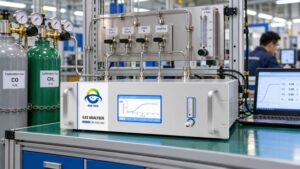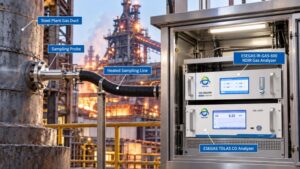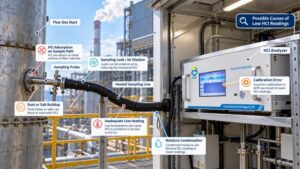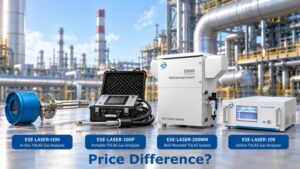



Two gas analyzers may both use TDLAS technology, yet their prices can differ by ten times or more. Why?
The answer is rarely the TDLAS itself. A compact gas detector and an industrial TDLAS gas analyzer may share similar optical principles. However, their measurement requirements, installation methods, and system designs can differ significantly.
For industrial buyers, the real cost often comes from measurement range, measurement sensitivity, optical design, gas sampling, and environmental protection. TDLAS gas analyzer prices vary because different applications require different measurement ranges, optical configurations, sampling systems, and operating capabilities. An in-situ analyzer measures gas directly inside a process. Meanwhile, an extractive system needs additional equipment to collect and condition the sample.

Understanding these differences helps engineers select the right TDLAS gas analyzer without paying for unnecessary features.
How Does TDLAS Gas Analyzer Technology Work?
Tunable Diode Laser Absorption Spectroscopy (TDLAS) measures gas concentrations through wavelength-specific light absorption.
A semiconductor laser emits light at a wavelength selected for the target gas. As the laser passes through the sample, gas molecules absorb part of the light. The analyzer measures this absorption and calculates the gas concentration using calibrated spectroscopic relationships.
Different gases absorb light at different wavelengths. Therefore, TDLAS systems can target specific gases with high selectivity. Common industrial applications include measuring CO, CO₂, O₂, CH₄, HCl, HF, NH₃, and H₂S.
Unlike electrochemical sensors, TDLAS does not rely on chemical reactions to measure gas concentration. This can reduce sensor consumption and certain interference problems. However, TDLAS is not completely immune to interference. Water vapor, overlapping absorption lines, pressure changes, and optical contamination can still affect measurements. The gas analyzer must account for these conditions through proper wavelength selection, calibration, and system design.
Why Can TDLAS Gas Analyzer Prices Differ by Ten Times?
Although two TDLAS gas analyzers may use the same measurement principle, their complete systems can be very different. Five major factors explain most technical cost differences.
1. How Does Measurement Range Affect Analyzer Cost?
A gas analyzer designed for percentage-level measurement has different requirements from one measuring parts-per-billion concentrations. For example, an analyzer measuring CO from 0–100% serves a different purpose from one measuring HCl at 0–1000 ppb. Low-concentration measurements may require better optical sensitivity, stable temperature control, advanced signal processing, and careful interference management.
As a result, ultra-low detection limits can increase system complexity and cost.
However, a lower measurement range does not automatically mean a higher price. Optical design, gas species, and application conditions also matter.
2. Why Does Optical Path Design Influence Price?
The optical path determines how laser light interacts with the measured gas.
In an in-situ system, the laser travels directly through a process duct or pipeline. The available optical path depends on the installation geometry.
In an extractive analyzer, the sample passes through a dedicated measurement cell. Some low-concentration applications use longer effective optical paths to increase absorption sensitivity.
Consequently, different optical configurations require different components, alignment methods, and maintenance procedures.
3. How Does Gas Sampling Increase System Cost?
The gas analyzer is only one part of a complete gas measurement system.
Industrial process gases may contain moisture, dust, corrosive compounds, and condensable substances. These conditions can affect both measurement accuracy and equipment reliability.
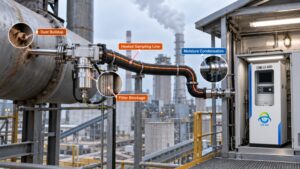
An extractive system may therefore require: A heated sampling probe and sampling line, Particulate filtration, A sampling pump and flow control, Temperature management and gas conditioning, Condensate management (where applicable), Calibration valves and gas connections. Each component adds equipment, installation, and maintenance costs.
Furthermore, sample conditioning must preserve the target gas. For example, excessive cooling may remove soluble gases such as HCl, HF, or NH₃ from the sample. Therefore, the correct sampling design matters more than simply adding more filters or cooling equipment.
4. Why Do Industrial Operating Conditions Matter?
A laboratory gas analyzer operates under relatively stable conditions. However, industrial installations can expose equipment to high temperatures, vibration, dust, and corrosive gases.
An in-situ TDLAS analyzer may require optical purge protection, suitable process flanges, and robust mounting structures. Meanwhile, an extractive system may require heated sampling equipment and a protected analyzer cabinet. These components increase the total system cost. However, they also help maintain reliable measurements under demanding operating conditions.
5. How Do Installation and Maintenance Affect Total Cost?
The purchase price does not represent the full cost of an industrial gas analyzer. Engineers should also consider installation, calibration, utilities, spare parts, maintenance, and potential process downtime.
For example, an in-situ analyzer avoids a long sample transport system. However, its optical windows still require protection and periodic inspection.
An extractive system offers more flexibility in analyzer placement. Nevertheless, pumps, filters, and sampling lines require maintenance.
Therefore, total cost of ownership (TCO) provides a better comparison than the initial analyzer price alone.
Which Types of TDLAS Gas Analyzers Are Available?
Industrial TDLAS gas analyzers generally fall into several categories based on installation, sampling method, and measurement requirements. ESEGAS provides in-situ, portable, wall-mounted, and online TDLAS solutions for different industrial applications.
What Is an In-Situ TDLAS Gas Analyzer?
The ESEGAS ESE-LASER-I100 In-Situ TDLAS Gas Analyzer measures gas directly inside industrial ducts or process pipelines.
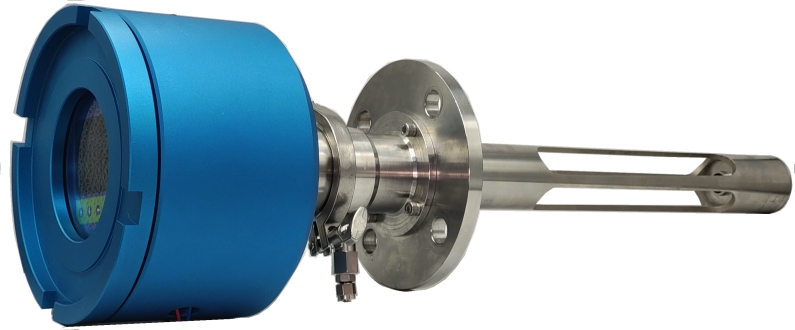
Its system consists of a transmitter unit, a receiving unit, and a purge unit. The laser beam travels through the process gas between the optical units. The gas analyzer supports CO, CO₂, and O₂ measurement, depending on the selected configuration.
Measurement ranges: 0–5%, 0–20%, or 0–50%, with customization available. Because the gas analyzer measures directly in the process, it avoids a conventional extractive sampling line. This design can reduce sample transport delays and eliminate some sampling components. However, engineers must consider optical alignment, dust accumulation, purge gas supply, and installation access.
Best suited for: Industrial furnaces, process ducts, and other applications requiring direct gas measurement.
What Is a Portable TDLAS Gas Analyzer?
The ESEGAS ESE-LASER-100P Portable TDLAS Gas Analyzer uses TDLAS technology for portable measurement of HCl, HF, and NH₃.
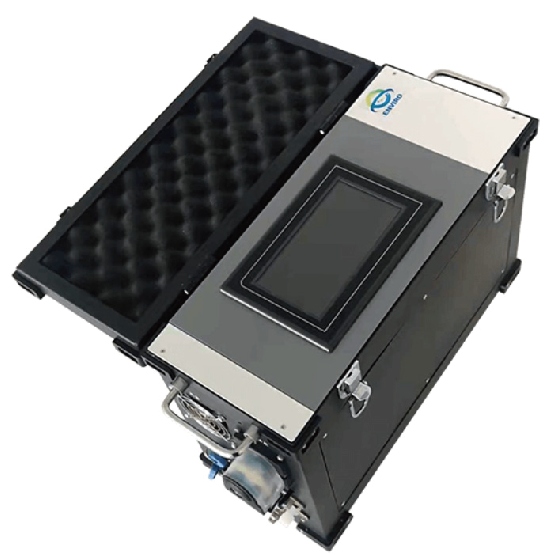
The system includes a portable sampling probe, heated tubing, and an internal sampling pump. These components allow technicians to collect and analyze sample gas at different measurement locations. Measurement ranges: HCl: 0–100 mg/m³, HF: 0–100 mg/m³, and NH₃: 0–200 ppm.
Portable gas analyzers provide flexibility for temporary measurements and field testing. For example, engineers may use portable equipment to investigate emissions at several sampling points.
However, portable operation does not eliminate sample handling requirements. Heated lines and suitable sampling procedures remain important when measuring reactive gases.
Best suited for: Temporary industrial emissions testing, field investigations, and multi-point measurement campaigns.
What Is a Wall-Mounted TDLAS Gas Analysis System?
The ESEGAS ESE-LASER-200WM Wall-Mounted TDLAS Gas Analysis System uses high-temperature extraction technology.
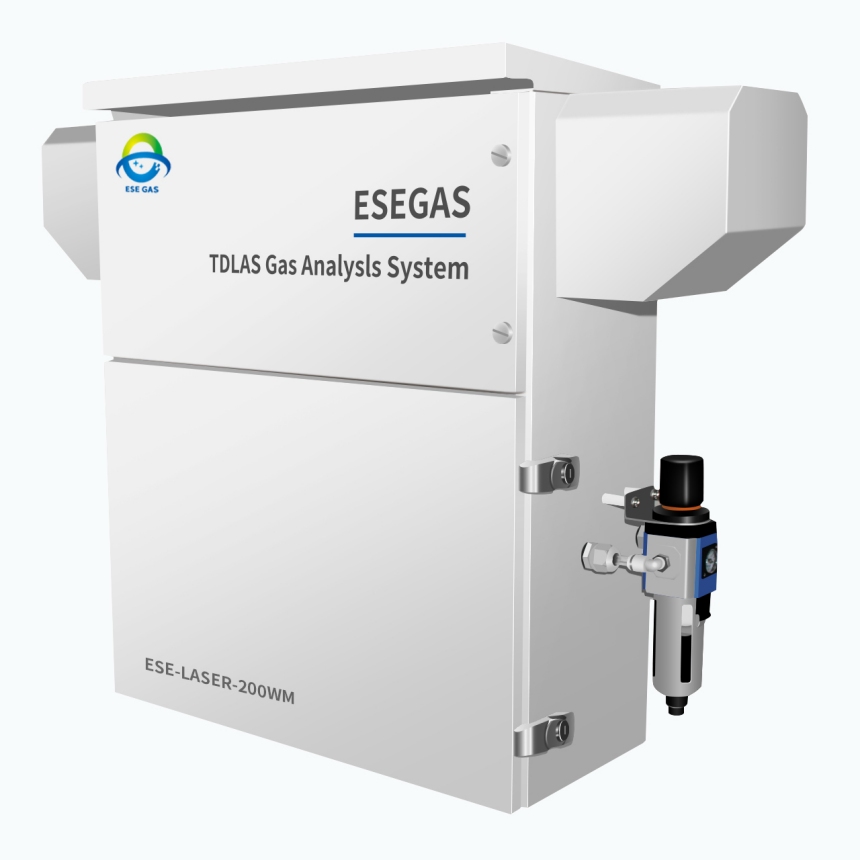
Its system includes a sampling transmission unit, a pretreatment control unit, and an analysis unit. It supports HCl, HF, and NH₃ measurement for industrial process and emissions applications. Measurement ranges: HCl: 0–10 ppm / 0–100 ppm, HF: 0–5 ppm / 0–50 ppm, and NH₃: 0–10 ppm / 0–200 ppm.
Unlike direct in-situ measurement, this system transports sample gas to an external analysis unit. The high-temperature extraction design helps manage sample transport for applications involving reactive gases. Nevertheless, engineers must control sample temperature and avoid condensation. Otherwise, soluble gases may be lost before reaching the analyzer.
Best suited for: Continuous HCl, HF, and NH₃ monitoring in industrial emissions and process applications.
What Is an Online TDLAS Gas Analyzer?
The ESEGAS ESE-LASER-100 Online TDLAS Gas Analyzer provides continuous online gas measurement using TDLAS technology. It supports different gas configurations, including HCl, HF, NH₃, O₂, H₂S, CO, CO₂, and CH₄. Selected configurations offer detection limits down to the ppb level.
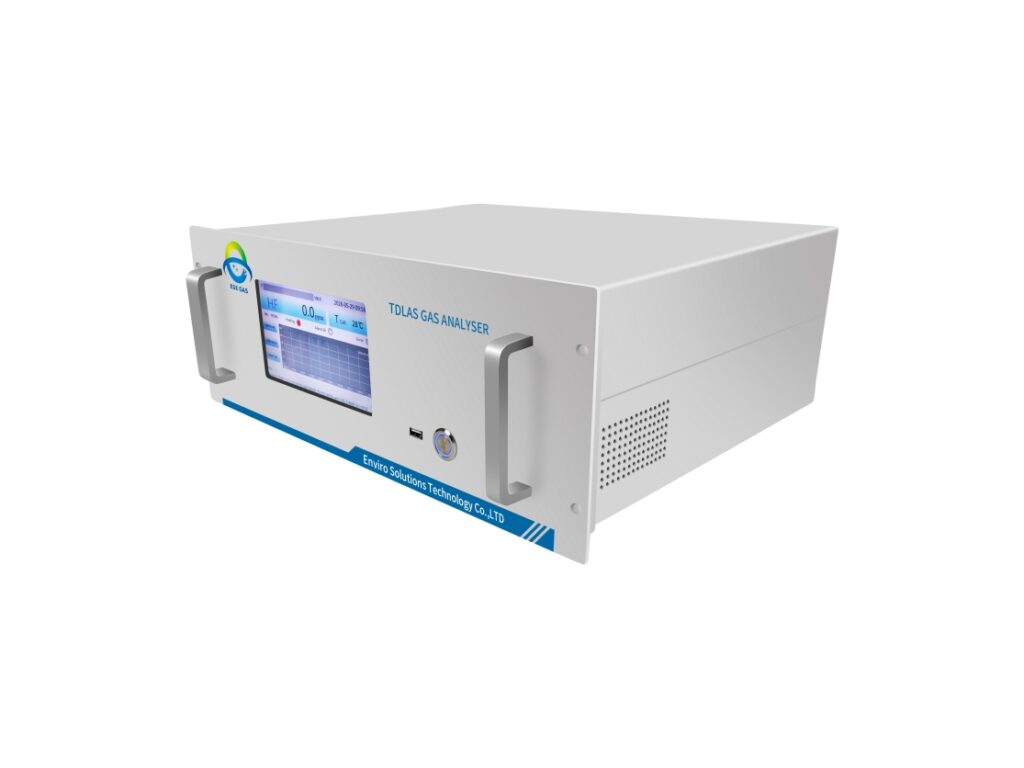
This makes the gas analyzer relevant to applications requiring low-concentration monitoring or broader process gas measurement ranges.
The available measurement ranges depend on the target gas and selected configuration. These ranges represent available gas-specific configurations, not simultaneous measurement of every listed gas.
Target gas | Available measurement ranges |
|---|---|
| HCl | 0–20 ppm / 0–200 ppm / 0–1000 ppb |
| HF | 0–10 ppm / 0–100 ppm / 0–2000 ppb |
| NH₃ | 0–50 ppm / 0–500 ppm / 0–1000 ppb |
| O₂ | 0–100% |
| H₂S | 0–30% / 0–500 ppm |
| CO | 0–100% / 0–500 ppm |
| CO₂ | 0–100% / 0–1000 ppm |
| CH₄ | 0–100% / 0–20 ppm |
For low-concentration applications, engineers should verify the detection limit, accuracy, response time, and sample conditions.
Best suited for: Continuous industrial process monitoring, low-concentration gas analysis, and applications requiring gas-specific TDLAS configurations.
How Do ESEGAS TDLAS Gas Analyzers Compare?
The four ESEGAS systems share the TDLAS measurement principle. However, they serve different installation and measurement requirements.
| Model | Configuration | Target gases | Main advantage |
|---|---|---|---|
| ESE-LASER-I100 | In-situ | CO, CO₂, O₂ | Direct process measurement |
| ESE-LASER-100P | Portable extractive | HCl, HF, NH₃ | Flexible field measurement |
| ESE-LASER-200WM | Wall-mounted extractive | HCl, HF, NH₃ | High-temperature extraction |
| ESE-LASER-100 | Online | HCl, HF, NH₃, O₂, H₂S, CO, CO₂, CH₄ | Broad gas-specific range options, including ppb configurations |
The most suitable gas analyzer depends on the measurement task rather than the number of available features. For example, a plant measuring percentage-level CO inside a process duct may prefer direct in-situ measurement.
Conversely, an emissions monitoring application involving low-level HCl may require a heated extractive system.
Is a More Expensive TDLAS Gas Analyzer Always Better?
A higher-priced TDLAS gas analyzer is not necessarily more suitable for every application. For example, an ultra-low-range TDLAS gas analyzer may offer little benefit when the process requires percentage-level CO measurement. Similarly, a portable TDLAS gas analyzer may be more practical than a fixed monitoring system for occasional field testing.
The same principle applies when comparing TDLAS with other technologies.
NDIR analyzers can provide cost-effective measurements for several infrared-active gases. Electrochemical sensors may also remain practical for certain low-concentration applications.
TDLAS becomes attractive when its gas selectivity, response characteristics, or non-contact optical measurement offers a meaningful advantage.
Ultimately, engineers should select the measurement technology according to performance requirements and operating conditions.
What Should You Check Before Requesting a TDLAS Gas Analyzer Quotation?
A useful quotation requires more information than the target gas name.
Before contacting a supplier, define the following requirements:
1. Target gases: Identify the gases and whether simultaneous measurement is necessary.
2. Measurement ranges: Specify normal concentrations, expected peaks, and required detection limits.
3. Process conditions: Provide temperature, pressure, moisture, dust, and corrosive gas information.
4. Installation method: Determine whether in-situ, portable, or extractive measurement is appropriate.
5. Performance requirements: Define accuracy, repeatability, response time, and calibration needs.
6. System scope: Clarify whether the quotation must include sampling, conditioning, installation accessories, and commissioning.
These details help manufacturers propose an appropriate configuration and avoid unnecessary equipment costs.
Frequently Asked Questions About TDLAS Gas Analyzer Prices
Why Are Some TDLAS Gas Analyzers More Expensive Than Others?
Prices differ because analyzers use different optical designs, measurement ranges, sampling equipment, and environmental protection systems. Installation and maintenance requirements also influence total cost.
Can One TDLAS Gas Analyzer Measure Multiple Gases?
Some systems support multiple gas channels or configurations. However, each target gas requires suitable absorption wavelengths and optical arrangements. A list of supported gases does not necessarily mean simultaneous measurement.
Is an In-Situ TDLAS Analyzer Better Than an Extractive Analyzer?
Neither configuration is universally better. In-situ systems measure directly inside the process and avoid sample transport. Extractive systems offer more flexibility in analyzer placement and sample handling.
Can TDLAS Gas Analyzers Measure ppb-Level Concentrations?
Yes. Certain TDLAS configurations support ppb-level measurement. However, achievable detection limits depend on the gas species, optical path, interference, and measurement conditions.
Do TDLAS Gas Analyzers Require Calibration and Maintenance?
Yes. Although TDLAS uses optical absorption rather than consumable chemical sensing reactions, analyzers still require performance verification. Optical windows, purge systems, and sampling components also need inspection.
How Can Buyers Reduce TDLAS Gas Analyzer Costs?
Buyers should define realistic measurement requirements and compare complete system costs. Avoid paying for unnecessary sensitivity, additional gas channels, or sampling equipment that the application does not need.
Conclusion
TDLAS gas analyzer prices differ because industrial measurement requirements vary widely. The laser is only one component. Optical design, sampling methods, detection limits, and operating conditions determine the complexity of the complete system.
For direct process measurement, an in-situ analyzer may simplify installation and reduce sampling requirements. Meanwhile, portable and extractive systems provide flexibility for field testing and continuous emissions monitoring.
Looking for a TDLAS gas analyzer for your industrial application? Contact ESEGAS with your target gases, measurement ranges, and process conditions. Our team can help evaluate suitable analyzer configurations and system requirements.