



Choosing the wrong gas analyzer measurement units can lead to incorrect process decisions, failed emissions reporting, and unnecessary troubleshooting. Understanding the difference between ppm, %Vol, and mg/Nm³ helps engineers interpret measurement data correctly and select the right gas analyzer for every application.
Gas analyzer measurement units describe gas concentration in different ways. ppm, ppb, and ppt indicate trace concentrations, %Vol represents the percentage of a gas in a mixture, while mg/Nm³ expresses the mass of a gas under normalized conditions. Each unit serves a different measurement purpose in industrial gas analysis.
Although these units often appear together on gas analyzer displays or environmental reports, they are not interchangeable. Some focus on gas volume, while others measure gas mass. Moreover, regulations and industrial standards often specify one unit over another. Let’s explore what each unit means and where it is commonly used.
What Are ppm, ppb, and ppt in Gas Analyzer Measurement Units?
ppm, ppb, and ppt are dimensionless concentration units representing parts per million, billion, and trillion. They are widely used for trace gas measurement because toxic gases, pollutants, and impurities often exist at extremely low concentrations that cannot be expressed effectively as percentages.
In fact, the use of gas analyzer measurement units depends entirely on the engineer’s requirements or the project’s operating conditions. Therefore, ppm, ppb, and sometimes pptshould be used appropriately based on the actual requirements.
These units express extremely small concentrations by comparing one part of a gas to the total gas mixture. In industrial gas analysis, ppm generally refers to volume concentration, making it ideal for measuring gases present at very low levels. One ppm equals 0.0001% by volume, while one ppb equals one-thousandth of one ppm.
For example, carbon monoxide inside a boiler flue may measure several hundred ppm, while hydrogen sulfide in natural gas pipelines may only reach a few ppm. Ambient air monitoring stations often report ozone or VOC concentrations in ppb because environmental pollutants exist at much lower levels.
Summary Table
| Unit | Meaning | Typical Range | Common Applications |
|---|---|---|---|
| ppm | Parts per million | 1–10,000 ppm | CO, SO₂, NOx, H₂S, (other gases under actual operating conditions) |
| ppb | Parts per billion | Below 1,000 ppb | VOCs, ozone, ambient air |
| ppt | Parts per trillion | Ultra-trace levels | Semiconductor manufacturing, laboratory analysis |
Comparison
| Feature | ppm | ppb | ppt |
|---|---|---|---|
| Concentration Level | Low | Very Low | Ultra Low |
| Typical Industry | Industrial processes | Air quality | Scientific research |
| Reading Resolution | Standard | High | Extremely High |
As gas concentrations become smaller, measurement sensitivity becomes increasingly important. However, not every application focuses on volume concentration alone. Environmental compliance often requires another type of measurement.
What Are mg/Nm³, mg/m³, and Nm³?
mg/m³ expresses the mass of gas contained in one cubic meter of air under actual operating conditions. mg/Nm³ reports mass concentration under normalized temperature and pressure, allowing fair comparison between different processes. The “N” in Nm³ stands for Normal, meaning the gas volume has been corrected to standard reference conditions.
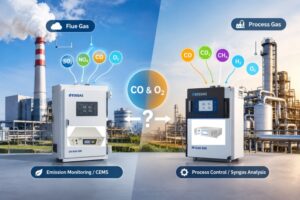
This distinction matters because gas expands and contracts as temperature and pressure change. Without normalization, two identical emission sources could report different concentrations simply because their operating conditions differ. For this reason, Continuous Emission Monitoring Systems (CEMS) commonly report pollutants such as SO₂, NOx, and particulate-related gases in mg/Nm³ instead of ppm.
Summary Table
| Unit | Definition | Reference Condition | Typical Application |
|---|---|---|---|
| mg/m³ | Mass per cubic meter | Actual conditions | Workplace air monitoring |
| mg/Nm³ | Mass per normal cubic meter | Normalized conditions | Stack emission monitoring |
| Nm³ | Normal cubic meter | Standard temperature and pressure | Environmental reporting |
Comparison
| Feature | mg/m³ | mg/Nm³ |
|---|---|---|
| Based on | Actual volume | Normalized volume |
| Temperature Influence | Yes | No |
| Pressure Influence | Yes | No |
| Regulatory Reporting | Limited | Widely required |
In short, ppm describes how much gas is present by proportion, while mg/Nm³ describes how much gas mass exists within a standardized gas volume.
What Is %Vol?
%Vol (Volume Percent) indicates the percentage of a gas within the total gas volume. It is commonly used when gas concentrations are relatively high, such as oxygen, carbon dioxide, methane, hydrogen, or process gases in industrial production and combustion systems.
Instead of measuring tiny fractions, %Vol shows the percentage of a specific gas within the total gas mixture. One percent by volume equals 10,000 ppm, making %Vol much easier to understand when gas concentrations are high.
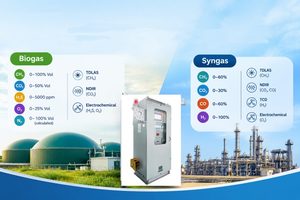
Many industrial process gases naturally exist in percentage ranges. Oxygen in ambient air is approximately 20.9%Vol. Carbon dioxide in fermentation systems may exceed 30%Vol. Hydrogen, methane, and nitrogen are also commonly measured in percentage ranges during industrial production and process control. Because of this, process gas analyzers frequently display %Vol for combustion optimization, inert gas monitoring, and syngas analysis.
Summary Table
| Gas | Typical Unit | Typical Measurement Range |
|---|---|---|
| Oxygen | %Vol | 0–25% |
| Carbon dioxide | %Vol | 0–100% |
| Hydrogen | %Vol | 0–100% |
| Methane | %Vol | 0–100% |
Comparison
| Feature | %Vol |
|---|---|
| Best for | High-concentration gases |
| Easy to Interpret | Yes |
| Used in Process Control | Yes |
| Suitable for Trace Gases | No |
As gas concentration increases, %Vol provides a clearer and more practical way to display analyzer readings than ppm.
How Do ppm, %Vol, and mg/Nm³ Compare?
Although these units all describe gas concentration, they answer different engineering questions.
- ppm measures the proportion of a gas within a mixture and is ideal for trace gases.
- %Vol measures larger gas fractions and simplifies high-concentration readings.
- mg/Nm³ measures gas mass under normalized conditions, making it the preferred unit for environmental reporting and regulatory compliance.
For instance, a combustion engineer may monitor oxygen in %Vol, a safety engineer may monitor carbon monoxide in ppm, and an environmental engineer may report sulfur dioxide in mg/Nm³. Each unit reflects the needs of a different application rather than indicating a different gas. Understanding this distinction prevents confusion when comparing analyzer readings, interpreting compliance reports, or reviewing technical specifications.
Conclusion
Understanding gas analyzer measurement units is essential for accurate process control, environmental compliance, and reliable gas analysis. Whether you work with ppm, %Vol, or mg/Nm³, selecting the correct unit helps ensure meaningful data and better operational decisions.
FAQs
What is the difference between ppm and %Vol?
ppm represents very small gas concentrations, while %Vol represents larger concentrations. One percent equals 10,000 ppm.
Why do emission reports often use mg/Nm³?
Because mg/Nm³ normalizes gas volume to standard conditions, it allows accurate comparison between different emission sources and operating environments.
Is Nm³ the same as m³?
No. A cubic meter (m³) is measured under actual operating conditions, while a normal cubic meter (Nm³) is corrected to standard reference temperature and pressure.
Can one gas be reported in different units?
Yes. The same gas may be displayed in ppm, %Vol, or mg/Nm³ depending on concentration level, industry standards, and reporting requirements.