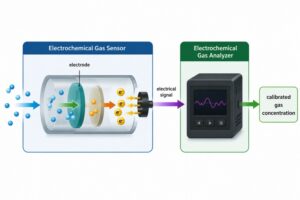




Carbon accounting sounds straightforward until real plant conditions begin to interfere with neat theoretical calculations. Many industrial operators still rely heavily on fuel data, emission factors, or periodic estimates, only to discover that fluctuating loads, changing fuel quality, and process instability can quietly undermine confidence in the final numbers. That becomes a serious problem when carbon disclosures, compliance reporting, and internal decarbonization plans all depend on data that must stand up to scrutiny. At ESEGAS, we see this gap every day: companies do not just need carbon data, they need carbon data that is continuous, credible, and usable.

CEMS can significantly improve carbon accounting by providing continuous, source-level emissions data that helps reduce estimation uncertainty, strengthen Scope 1 reporting, and support robust monitoring, reporting, and verification practices. In industrial settings where operating conditions change frequently, CEMS offers a more transparent and auditable foundation for carbon management than methods that rely only on generalized factors or periodic calculations. Direct measurement methods in greenhouse gas accounting commonly include continuous emissions monitoring, while robust MRV frameworks emphasize accuracy, transparency, consistency, and verification.
That is the short answer, but the more useful question is how this works in practice. Knowing that CEMS can support carbon accounting is not the same as understanding where it fits, when it is most valuable, and what companies must do to turn monitoring data into defensible carbon records. From our perspective at ESEGAS, that practical layer is where real value is created.
What Role Does CEMS Play in Carbon Accounting?
Many facilities already collect emissions-related data, yet those measurements often remain isolated inside environmental compliance workflows instead of becoming part of a broader carbon strategy. That separation creates friction: operators may be monitoring stack conditions, but sustainability teams still depend on estimated carbon outputs. When that happens, monitoring and accounting are not truly connected. At ESEGAS, we view CEMS as the bridge that converts raw emissions monitoring into a reliable carbon data stream.
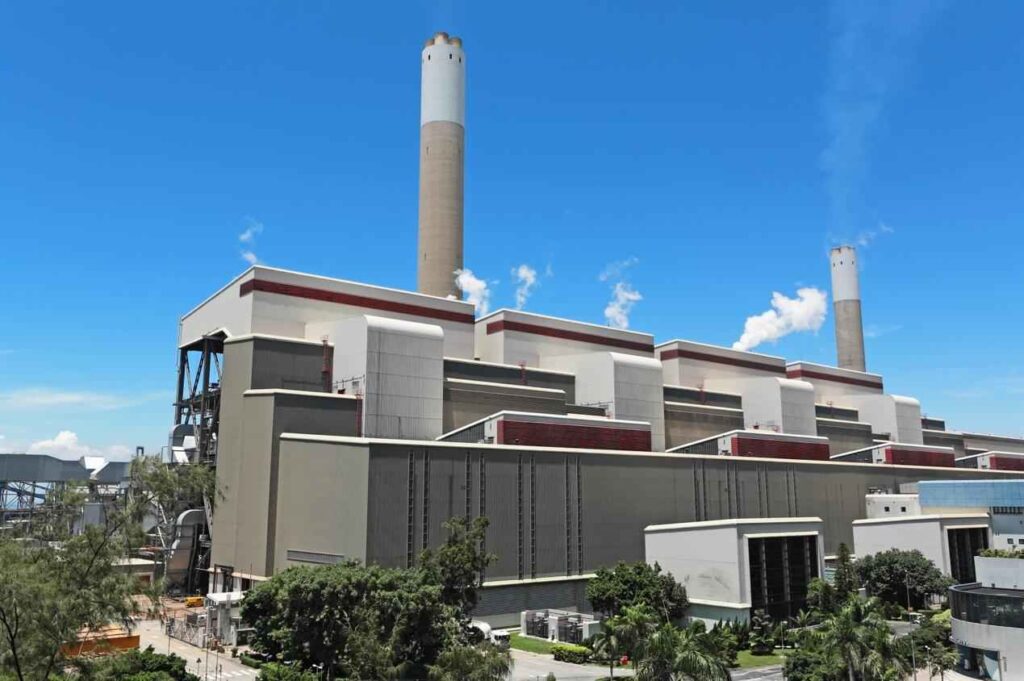
In carbon accounting, CEMS helps companies move from approximation toward direct observation by continuously tracking emissions-related parameters at the source. EPA defines a CEMS as the total equipment needed to determine gas or particulate concentration or emission rate using analyzer measurements and conversion methods, and greenhouse gas accounting guidance recognizes continuous emissions monitoring as a direct measurement approach.
From a practical standpoint, CEMS can support carbon accounting in several ways:
- It provides continuous source-level data rather than isolated snapshots.
- It helps quantify CO2 emissions directly, especially in large stationary sources.
- It improves the quality of Scope 1 emissions reporting for combustion or process sources where direct monitoring is appropriate.
- It creates a stronger evidentiary basis for audits, verification, and performance analysis.
- It allows carbon management teams to work with operationally relevant data instead of annualized estimates alone.
At ESEGAS, we see the greatest value when CEMS data is not treated as a compliance byproduct, but as a strategic input for carbon accounting, emissions analysis, and long-term decarbonization planning.
Why Is CEMS More Reliable Than Estimation-Based Carbon Accounting Methods?
A company can produce a carbon inventory with fuel records and emission factors, but that does not automatically mean the result captures what truly happened in the stack. In facilities with varying loads, mixed fuels, unstable process conditions, or multiple emissions sources, estimation-based methods can miss important fluctuations. The risk is not merely technical. Once reported carbon numbers influence compliance, customer trust, or investment narratives, uncertainty becomes a business issue. This is exactly why CEMS matters.
The key strength of CEMS is that it reflects actual operating conditions over time. By contrast, factor-based methods depend on assumptions about fuel characteristics, oxidation rates, or average performance. Those methods remain useful and widely accepted in many contexts, but direct monitoring can provide a stronger data foundation where emissions are large, continuous, or highly variable. Greenhouse gas guidance explicitly distinguishes direct measurement approaches such as continuous emissions monitoring from calculation-based methods.
Here is the practical comparison:
| Method | Main Data Basis | Strength | Limitation |
| CEMS | Continuous source measurement | High data granularity, better operational visibility, strong traceability | Requires robust installation, QA/QC, and data management |
| Emission factor method | Fuel or activity data × factor | Efficient and scalable | Less responsive to real-time process variation |
| Fuel-based estimation | Consumption and composition assumptions | Useful where direct measurement is unavailable | Can diverge from actual stack emissions under changing conditions |
At ESEGAS, we do not present CEMS as a universal replacement for every accounting method. We see it as the most powerful option where companies need higher confidence, better temporal resolution, and stronger auditability.
Which Industries Benefit Most from Using CEMS for Carbon Accounting?
Not every sector faces the same carbon accounting challenge. Some facilities operate with relatively stable inputs and modest emissions volumes, while others run continuous, high-temperature, high-throughput processes where emissions profiles can shift hour by hour. In those environments, relying only on generalized estimates can leave decision-makers with an incomplete picture. The more material and dynamic the emissions source, the more valuable CEMS becomes.
Industries with large stationary combustion or process emissions often gain the most from integrating CEMS into carbon accounting. EPA programs already require continuous measurement and reporting of CO2 for many large fossil-fuel-fired power plants, which shows how important direct monitoring can be in high-emission settings.
The strongest fit is usually found in sectors such as:
- Power generation
- Cement manufacturing
- Iron and steel
- Petrochemical and chemical processing
- Waste incineration
- Glass, ceramics, and other high-temperature industrial operations
These sectors tend to share several characteristics:
- continuous or semi-continuous emissions,
- material Scope 1 impact,
- complex process conditions,
- stronger compliance or verification pressure,
- and greater need for defensible decarbonization data.
At ESEGAS, we focus on helping industrial operators in these demanding environments build monitoring frameworks that are stable enough for plant realities and precise enough for carbon accountability.
How Does CEMS Support MRV, Compliance, and Carbon Audits?
Carbon accounting does not end when a number appears in a spreadsheet. That number must often move through internal review, external disclosure, third-party verification, and sometimes regulatory reporting. If the underlying data trail is weak, even a reasonable estimate may be questioned. That is why companies need more than measurement alone. They need a monitoring structure that can withstand scrutiny.
This is where CEMS supports MRV in a meaningful way. The EU ETS describes effective MRV as robust, transparent, consistent, and accurate, and that language aligns closely with the strengths of well-managed continuous monitoring.
In practical terms, CEMS contributes to MRV by helping companies:
- monitor emissions continuously rather than intermittently,
- report with stronger source-level evidence,
- maintain historical data records for review and analysis,
- support verification with traceable measurement data,
- and connect environmental monitoring to formal carbon reporting workflows.
However, technology alone is not enough. A credible CEMS-based carbon accounting framework also depends on calibration, quality assurance, maintenance discipline, and clear documentation. At ESEGAS, we emphasize this full-chain view because the credibility of carbon data depends on both analyzer performance and data governance.
What Data Challenges Should Companies Solve Before Using CEMS in Carbon Accounting?
Many facilities assume that once a CEMS is installed, the carbon accounting problem is solved. In reality, poor data structuring can undermine even a technically sound system. A plant may have continuous measurements available, yet still struggle to generate reliable carbon reports because source boundaries are unclear, data gaps are not handled consistently, or monitoring outputs are not integrated with reporting logic. The result is frustration: plenty of data, but limited confidence.
To make CEMS truly effective in carbon accounting, companies should address several common issues early:
- Boundary definition: Determine exactly which stacks, units, and process sources belong in the carbon inventory.
- Data completeness: Establish rules for downtime, invalid readings, and missing records.
- QA/QC routines: Apply calibration and validation procedures so measured values remain defensible over time.
- System integration: Ensure CEMS outputs can flow into plant data systems, emissions platforms, or carbon reporting tools.
- Multi-source consolidation: Standardize how emissions from multiple lines or stacks are aggregated for reporting.
Greenhouse gas accounting guidance also highlights the importance of minimizing uncertainty and supporting credibility through strong data quality practices.
At ESEGAS, we believe the most successful projects are the ones that treat CEMS not as a standalone instrument package, but as part of a larger carbon data architecture.
How Can We at ESEGAS Help Companies Build a More Accurate Carbon Monitoring Framework?
Most industrial companies are not looking for equipment in isolation. They are looking for confidence: confidence that the monitoring system will remain stable under real operating conditions, that the data will be meaningful for carbon accounting, and that the investment will support both compliance and long-term sustainability objectives. Without that confidence, even advanced monitoring technology can fail to deliver strategic value.
At ESEGAS, we approach CEMS from the standpoint of real industrial application. We understand that carbon accounting depends on more than a measurement principle. It depends on analyzer reliability, system suitability, data continuity, and practical integration into plant operations and reporting processes.
That is why our focus is on helping customers:
- improve the quality and continuity of emissions data,
- strengthen source-level CO2 monitoring capability,
- support more credible Scope 1 carbon accounting,
- build a stronger data basis for compliance and verification,
- and create a monitoring framework that also serves operational improvement and decarbonization planning.
We believe better carbon accounting starts with better emissions insight. When CEMS data is stable, traceable, and aligned with reporting needs, it becomes far more than a monitoring output. It becomes a foundation for better industrial decision-making.
In carbon accounting, accuracy is not a luxury. It is the basis for credibility, compliance, and effective emissions reduction. CEMS helps companies move beyond generalized estimates by bringing continuous, source-level visibility into the carbon reporting process. For industrial operators facing complex conditions and rising expectations around transparency, that shift can be transformative. At ESEGAS, we see CEMS not simply as an environmental monitoring tool, but as a critical part of a modern carbon management strategy built on reliable data, practical implementation, and long-term value.