



In gas analysis, uncertainty is expensive. When a monitoring system delivers unstable readings, misses concentration changes, or struggles with harsh process conditions, the result is more than a technical inconvenience. It can affect combustion efficiency, emissions compliance, process safety, and maintenance planning. At ESEGAS, we see this challenge across industrial gas monitoring applications, which is exactly why the NDIR analyzer remains one of the most trusted technologies for accurate and continuous gas measurement.
An NDIR analyzer is a non-dispersive infrared gas analyzer that measures gas concentration by detecting how specific gas molecules absorb infrared light at characteristic wavelengths. It is widely used for gases such as CO2, CO, CH4, and other infrared-active gases because it offers strong selectivity, stable performance, and suitability for continuous monitoring.
That definition explains the technology at a high level, but it does not yet answer the questions that matter most in real projects: how the analyzer works, which gases it can measure, where it performs best, and how to choose the right configuration for an industrial application. From our perspective at ESEGAS, understanding those points is what turns a general interest in NDIR technology into a practical gas analysis solution.
How Does an NDIR Analyzer Work?
Many buyers know that an NDIR analyzer is widely used, but they are not always sure why it works so reliably in so many gas measurement tasks. That gap matters. Without understanding the basic sensing principle, it is difficult to judge whether the analyzer fits the gas, the range, and the operating environment. At ESEGAS, we believe that a clear understanding of the measurement principle leads to better analyzer selection and better long-term performance.
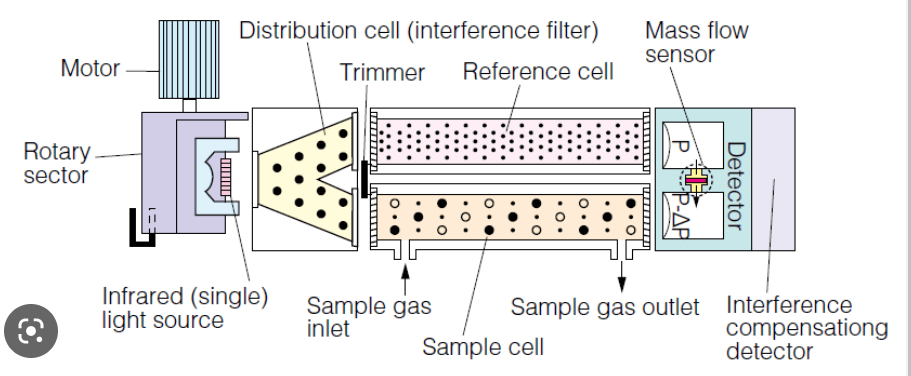
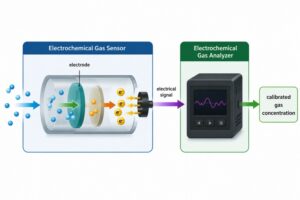
An NDIR analyzer works by sending infrared radiation through a sample gas chamber and measuring how much light is absorbed at a target wavelength. Because each infrared-active gas has its own absorption characteristics in the infrared region, the analyzer can relate the reduction in transmitted infrared energy to gas concentration. Typical NDIR designs include an infrared source, an optical path or gas cell, filters, and a detector. This principle is widely used in infrared gas analyzers for continuous measurement.
In practical terms, the process looks like this:
- An infrared source emits radiation through the measurement path.
- The target gas absorbs specific wavelengths of that radiation.
- The detector measures the remaining signal after absorption.
- The analyzer converts that signal change into a concentration reading.
This optical measurement approach is one reason NDIR technology is valued for continuous gas analysis: it is straightforward in principle, well established in industry, and suitable for stable online monitoring.
What Gases Can an NDIR Analyzer Measure?
One of the most common misunderstandings in gas analysis is the assumption that one analyzer technology can measure every gas equally well. In reality, matching the sensing principle to the gas component is essential. If that match is wrong, accuracy, selectivity, and long-term reliability all suffer. That is why we always help customers define the target gases before discussing analyzer configuration.
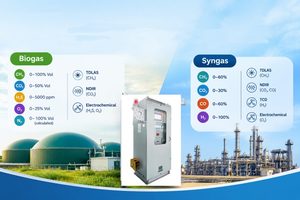
NDIR analyzers are primarily used for infrared-active gases, including CO2, CO, CH4, and a range of hydrocarbons. Industrial product documentation and EPA materials also show NDIR-based analyzers being used for gases such as SO2 and NO in certain analyzer configurations.
A practical way to view it is this:
- CO2: widely measured with NDIR in process, environmental, and indoor air applications.
- CO: a classic NDIR application in combustion and emissions analysis.
- CH4: commonly measured in natural gas, biogas, and methane-related monitoring.
- Hydrocarbons and some refrigerant-type gases: often suitable when they show usable infrared absorption characteristics.
Not every important industrial gas is an NDIR gas. Oxygen, for example, is commonly measured with paramagnetic or other dedicated oxygen analyzer technologies rather than by standard NDIR measurement. That is why some multigas systems combine NDIR channels for infrared-sensitive gases with a separate oxygen cell.
What Are the Main Advantages of an NDIR Analyzer?
A low upfront instrument price can look attractive, but in real operation the more important question is whether the analyzer will stay stable, selective, and manageable over time. Many facilities discover too late that poor analyzer fit leads to drift, frequent intervention, and unreliable process data. At ESEGAS, we focus on solutions that make day-to-day gas measurement more dependable, not just cheaper on paper.
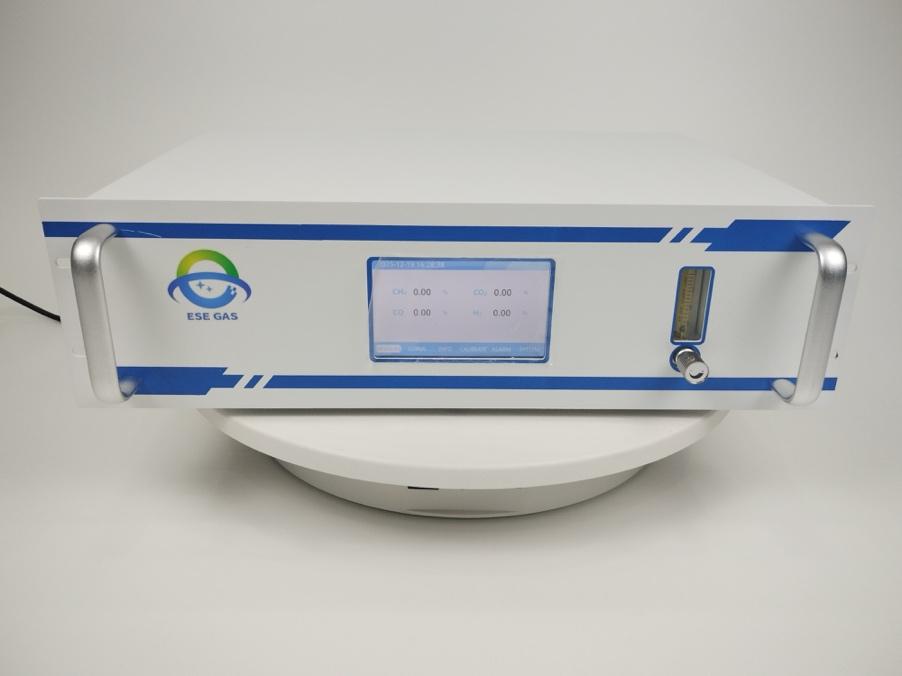
One major advantage of an NDIR analyzer is selective measurement based on infrared absorption. Because the analyzer targets characteristic wavelengths, it can distinguish relevant gases effectively in many applications. Another advantage is that NDIR analyzers are widely recognized for continuous measurement suitability, simple structure, and relatively easy maintenance in comparison with some more complex alternatives.
From an application standpoint, the strengths are clear:
- Strong suitability for continuous online gas monitoring.
- Proven performance in measuring common industrial gases such as CO2, CO, and CH4.
- Optical measurement architecture that is well established in industrial analyzer design.
- Broad use across emissions, process, and environmental applications, showing strong practical reliability.
For many customers, the real advantage is not one single specification. It is the balance of accuracy, stability, application maturity, and integration flexibility that makes the NDIR analyzer such a dependable choice in industrial gas analysis. That is the value we aim to deliver in every ESEGAS solution.
Where Are NDIR Analyzers Commonly Used?
Even a strong measurement technology only creates value when it fits the application. Many users do not just want to know what an NDIR analyzer is. They want to know where it proves itself in the field. That is the right question, because actual operating conditions ultimately determine whether an analyzer performs as expected.
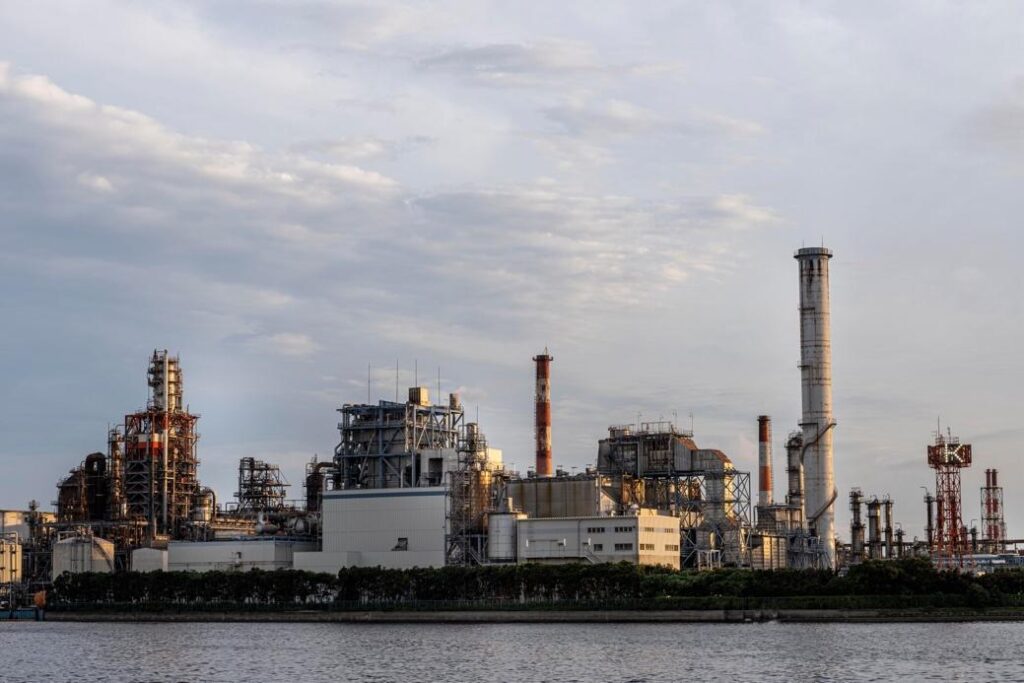
NDIR analyzers are widely used in industrial process monitoring, combustion analysis, emissions measurement, and other applications requiring continuous gas concentration data. EPA verification materials and industrial analyzer documentation show NDIR technology in use for combustion-source testing and multigas process analysis, while industry references also describe NDIR as suitable for continuous measurement in on-site applications.
Common application areas include:
- Combustion efficiency monitoring, especially where CO or CO2 data is important.
- Flue gas and emission monitoring in industrial systems.
- Natural gas, methane, and biogas-related analysis where CH4 measurement is required.
- Environmental and indoor air quality measurement, particularly for CO2-focused monitoring.
- Integrated multigas analyzer systems that combine NDIR with oxygen measurement using another sensing method.
At ESEGAS, we view these applications through a practical lens: the best analyzer is the one configured for the real gas matrix, the real installation conditions, and the real operational objective.
How Do You Choose the Right NDIR Analyzer for Your Application?
A surprising number of gas analysis problems begin before the analyzer is ever installed. The issue is not always the technology itself. It is often a mismatch between the analyzer specification and the application demands. That is why selection is just as important as measurement principle. At ESEGAS, we treat analyzer selection as an engineering decision, not a catalog exercise.
When choosing an NDIR analyzer, the first step is to define the target gas or gases and confirm that they are suitable for infrared measurement. Next, the measurement range, required accuracy, and expected response behavior should be aligned with the process objective. For multicomponent applications, it is also important to determine whether the system should combine NDIR channels with another technology such as a paramagnetic oxygen analyzer.
We recommend evaluating at least these points:
- The gas component to be measured and whether it is infrared-active.
- The concentration range and whether low-level or percentage-level measurement is needed.
- The sample conditions, including humidity, dust, pressure, and temperature, because sampling design affects analyzer performance in real plants. This is a practical engineering inference based on how industrial analyzers are deployed with application-specific sampling systems.
- Whether the project requires single-gas or multigas analysis.
- The level of system integration and service support needed after installation. This is an operational inference, but it follows from the fact that industrial analyzers are typically delivered as part of larger monitoring systems rather than as isolated instruments.
From our perspective, the right NDIR gas analyzer is not simply the one with the longest feature list. It is the one whose sensing principle, measurement range, and system design match the process reality.
Why Choose ESEGAS for NDIR Gas Analysis Solutions?
Many suppliers can offer an analyzer. Fewer can help turn analyzer hardware into a stable, useful, long-term gas analysis solution. In industrial environments, that difference matters. Customers do not only need a reading on a screen. They need dependable measurement that supports control decisions, compliance work, and equipment performance.
At ESEGAS, we approach the NDIR analyzer as part of a complete application solution. Because NDIR technology is broadly used for continuous gas measurement and can be combined with additional sensing methods in multigas systems, the real value comes from correct configuration, application fit, and support through implementation. That is the perspective we bring to analyzer projects.
From the ESEGAS point of view, our value lies in four areas:
- We focus on application-oriented analyzer selection, not generic product matching.
- We support customers in aligning the analyzer with the target gas, range, and operating conditions.
- We understand that reliable gas analysis depends on both the measurement technology and the system design around it.
- We aim to provide NDIR gas analysis solutions that are practical for continuous industrial use, where stability and clarity of data matter every day.
That is why, when customers evaluate an infrared gas analyzer for process or emissions work, we do not start with a sales pitch. We start with the measurement task.
Conclusion
An NDIR analyzer is one of the most important technologies in modern gas measurement because it uses infrared absorption to measure gases such as CO2, CO, CH4, and other infrared-active components with strong practical value in continuous monitoring. Its established measurement principle, broad industrial use, and compatibility with multigas system design make it a dependable choice across many applications.
At ESEGAS, we believe the real key is not only understanding what an NDIR analyzer is, but also knowing where it fits, where its limits are, and how to configure it correctly for actual working conditions. That is how better gas analysis decisions are made, and that is the standard we aim to bring to every solution we provide.