



Natural gas power plants often lose efficiency in ways operators cannot see. Imprecise combustion control, excess air, and delayed feedback quietly increase fuel consumption. Process gas analyzers solve this problem with real-time insight. They continuously measure key gases inside the combustion process.
Among all measurements, oxygen stands out as the most critical signal. It directly reflects how much excess air remains after combustion. More importantly, oxygen control connects efficiency, safety, and compliance. Accurate O₂ measurement helps prevent incomplete combustion and limits CO formation. At the same time, it avoids over-oxidation that drives NOx emissions. This turns combustion from a reactive process into a controlled system.
Many plants still operate with hidden efficiency losses. A process gas analyzer turns those losses into measurable, recoverable savings.
What Gases Should a Process Gas Analyzer Monitor in Natural Gas Power Plants—and Where?
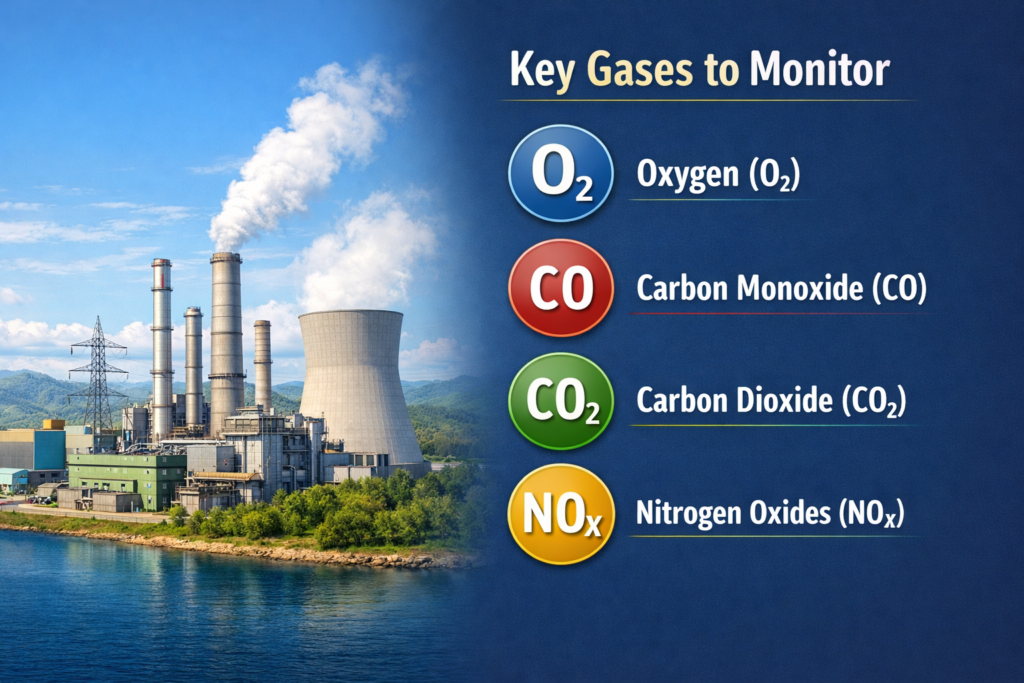
In natural gas power plants, combustion produces a mix of gases that directly reflect efficiency and safety. A process gas analyzer tracks the most critical components in real time. The key gases include oxygen (O₂), carbon monoxide (CO), carbon dioxide (CO₂), and nitrogen oxides (NOx).
Oxygen shows excess air and combustion balance. Carbon monoxide signals incomplete combustion and energy loss. Carbon dioxide indicates how fully the fuel burns. NOx represents high-temperature combustion byproducts and emission risk. Together, these gases give a complete picture of combustion performance. Operators use this data to adjust the air-fuel ratio and improve efficiency.
These gases must be monitored at key points across the power plant. Each location provides different insights into the combustion process.
- Inside the combustion chamber, analyzers track oxygen and CO to control the air-fuel ratio in real time. This is where combustion actually happens, so fast feedback is critical.
- In the HRSG or boiler section, flue gas continues to transfer heat before release. Monitoring here helps evaluate heat recovery efficiency and combustion stability.
- At the flue gas stack, analyzers measure O₂, CO₂, CO, and NOx before emission. This ensures compliance and confirms overall combustion quality.
By combining measurements from these locations, operators gain full visibility. They move from isolated readings to system-wide optimization.
How Does Oxygen Monitoring in a Process Gas Analyzer Drive Efficiency Optimization?
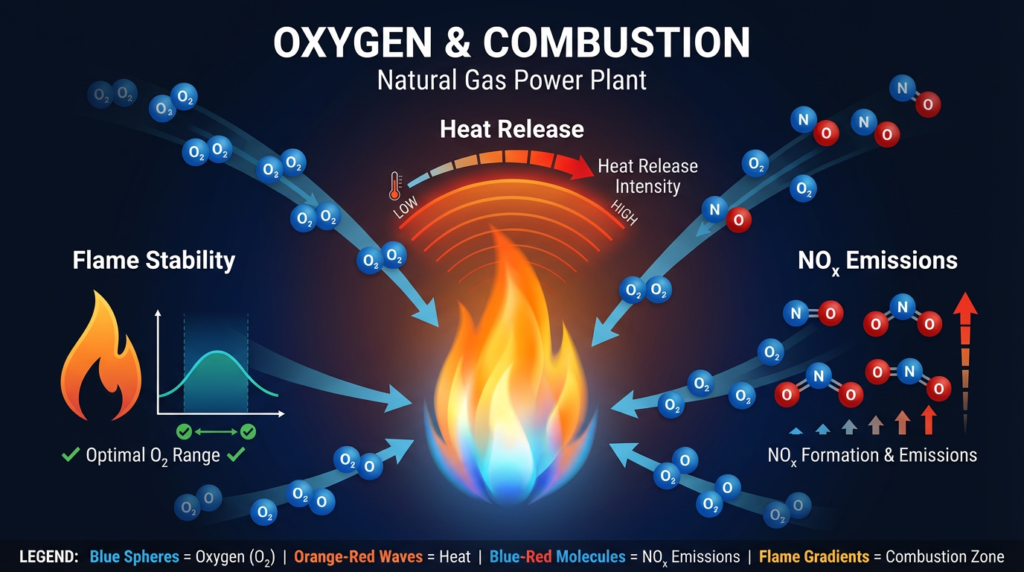
Oxygen works as the control knob of combustion in natural gas power plants because it directly defines the air-to-fuel ratio, which in turn determines flame stability, heat release, and emission formation, so operators do not really control combustion itself but instead control oxygen levels to influence the entire process, and this is why all effective combustion optimization strategies ultimately come down to precise oxygen control.
Excess air remains one of the largest hidden sources of energy loss because operators add extra air to ensure safety, but too much oxygen means additional gas must be heated and discharged, wasting energy, so an oxygen analyzer enables oxygen trim control by continuously adjusting the air supply to match real combustion demand, which reduces unnecessary excess air, improves thermal efficiency, and lowers fuel consumption, and even a small increase of 1% O₂ can lead to about a 0.5% efficiency loss.
Combustion conditions also change constantly due to load shifts, fuel quality, and ambient factors, so real-time oxygen feedback becomes essential because the analyzer detects small O₂ fluctuations instantly and sends signals to the control system, allowing burners to adjust automatically, which stabilizes the flame, reduces CO spikes caused by incomplete combustion, and improves overall operational safety.
Traditional extractive systems often respond too slowly because sampling and conditioning introduce delays, while in-situ oxygen measurement eliminates this lag by measuring directly inside the process, enabling faster control loop response and immediate correction, which minimizes process deviation and keeps combustion closer to its optimal state.
Many plants still operate with conservative safety margins by maintaining higher excess air than necessary, but accurate oxygen data allows operators to move from fixed settings to data-driven control, reducing reliance on guesswork and unlocking hidden efficiency gains without compromising safety, ultimately turning combustion into a precise and optimized process.
How Do Process Gas Analyzers Improve Overall Performance in Natural Gas Power Plants?
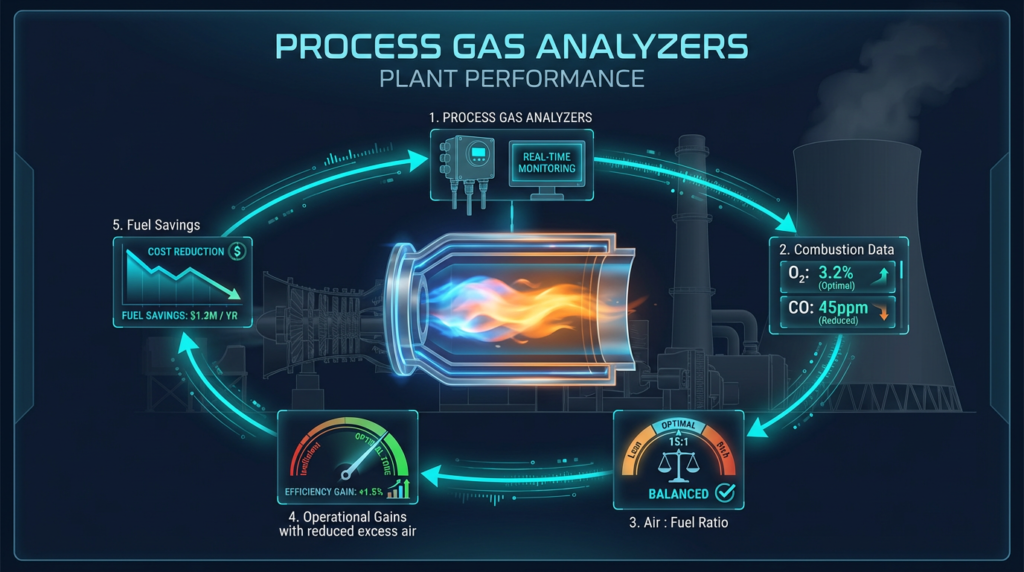
Process gas analyzers improve plant performance by turning combustion data into direct operational gains, because optimized air-to-fuel ratio reduces unnecessary fuel consumption, and even small improvements in excess air control can deliver measurable savings at scale, making fuel cost reduction one of the fastest and most visible returns on investment for power plant operators.
At the same time, proper oxygen balance helps control emission formation, since too much or too little oxygen increases pollutants like NOx and CO, while accurate monitoring keeps combustion within the optimal window, ensuring stable emissions output and helping plants meet environmental regulations without additional corrective systems.
Beyond efficiency and compliance, gas analyzers also protect critical equipment by maintaining clean and stable combustion conditions, which prevents soot buildup, reduces fouling in heat exchangers, and minimizes thermal stress on burners and boilers, ultimately extending asset life and lowering maintenance frequency over time.
When integrated with DCS or SCADA systems, process gas analyzers enable closed-loop control by feeding real-time data directly into the control logic, allowing automatic adjustments across the plant, which transforms combustion from manual operation into a continuous optimization process that responds instantly to load changes and operating conditions.
Conclusion
Natural gas power plant efficiency always comes down to how well combustion is controlled, because every unit of fuel must mix with the right amount of air to release maximum energy, and when this balance drifts, plants either waste fuel or create unsafe and unstable conditions, so in practice efficiency is not just an equipment issue but a combustion control challenge that operators must manage continuously.
At the core of this control lies oxygen, since it directly reflects whether the air-to-fuel ratio is too high or too low, and every adjustment in combustion ultimately traces back to oxygen levels, which means controlling combustion is essentially controlling oxygen, making O₂ measurement the most important feedback signal in the entire process.
This is why a process gas analyzer, especially an oxygen analyzer, plays a much bigger role than a simple measurement device, because it provides real-time data that operators use to fine-tune combustion, reduce fuel waste, maintain stable operation, and keep emissions within limits, turning invisible losses into clear optimization opportunities.
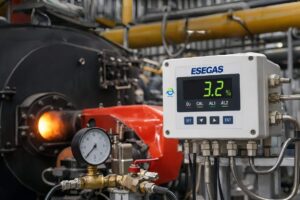
In real terms, ESEGAS process gas analyzer are ready to sit in your system, contact with us for the tailored natural gas monitoring solution.
Conclusion
1. Why is a process gas analyzer important in natural gas power plants?
A process gas analyzer provides real-time data on key gases like O₂, CO, CO₂, and NOx, allowing operators to optimize combustion, improve efficiency, and maintain safe operation. Without accurate gas measurement, plants rely on assumptions, which leads to fuel waste and unstable performance.
2. Why is oxygen monitoring the most critical measurement in combustion?
Oxygen directly reflects the air-to-fuel ratio, which determines combustion efficiency, flame stability, and emissions. By controlling oxygen levels, operators can fine-tune combustion and reduce excess air, making O₂ the most important parameter for efficiency optimization.
3. How does a process gas analyzer reduce fuel consumption?
A process gas analyzer enables precise oxygen trim control, which minimizes excess air in combustion. This reduces the amount of unused gas being heated, improving thermal efficiency and lowering overall fuel consumption. Even small improvements can lead to significant cost savings.
4. Where are process gas analyzers installed in power plants?
Process gas analyzers are typically installed at:
- Combustion chambers (for real-time control)
- HRSG or boilers (for efficiency monitoring)
- Flue gas stacks (for emissions compliance)
Each location provides different insights into system performance.
5. How much efficiency improvement can an oxygen analyzer achieve?
In many cases, optimizing oxygen levels can improve efficiency by 1–3%. This may seem small, but in large power plants, it translates into substantial annual fuel savings and lower operating costs.
6. How do process gas analyzers help reduce emissions?
By maintaining the correct oxygen balance, process gas analyzers reduce incomplete combustion and prevent excessive temperatures, which lowers CO and NOx emissions. This helps plants meet environmental regulations without additional treatment systems.