



Global fruit supply chains operate within a narrow ripeness window. Delivering fruit too early reduces taste and consumer acceptance. Delivering too late leads to spoilage and waste. This balance becomes harder across long-distance transport and storage. Producers must use process gas analyzer to control ripening precisely, not just monitor it. Otherwise, even small deviations can affect entire batches and reduce market value.
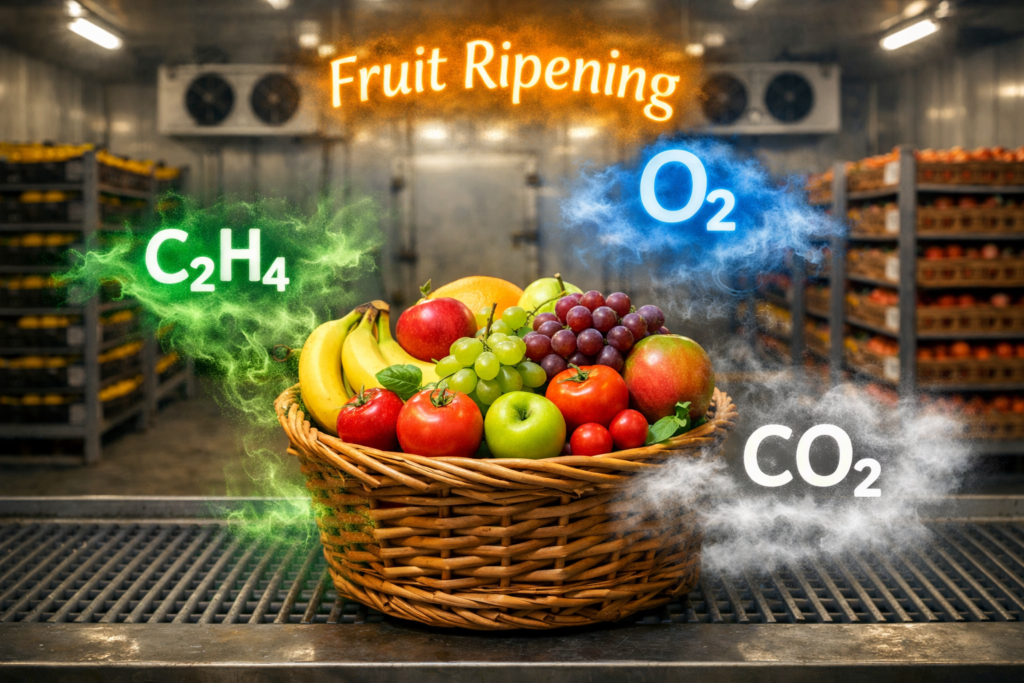
Fruit ripening is a gas-driven biochemical process, not a random event. BEthylene (C2H4) acts as the primary trigger, while oxygen and carbon dioxide regulate respiration. As fruits ripen, they release ethylene, which accelerates further ripening in a chain reaction . At the same time, fruits consume oxygen and release carbon dioxide, forming a dynamic gas environment that directly impacts quality and shelf life.
Process gas analyzers change this approach from reactive to proactive. They deliver real-time, continuous measurement of key ripening gases, enabling immediate process adjustments. Meanwhile, Operators can inject, dilute, or balance gases based on live data instead of assumptions. This transforms fruit handling into a data-driven, controlled process, improving consistency, reducing waste, and optimizing time-to-market.
T the challenge is clear, the next step is to understand the science behind these gases and how they interact during ripening.
What Gases Must a Process Gas Analyzer Control in Fruit Ripening?
Ethylene – The Primary Ripening Trigger
Ethylene (C₂H₄) acts as a natural plant hormone that initiates ripening. And It controls key changes such as color, texture, and sugar development. Even trace levels can activate the process. In many cases, concentrations below 1 ppm already trigger ripening. Once started, the process accelerates quickly. Fruits begin producing more ethylene on their own, creating a self-amplifying effect. This autocatalytic behavior explains why one ripe fruit can influence an entire batch. In enclosed environments, ethylene can accumulate rapidly and push products beyond optimal ripeness. Therefore, precise monitoring and control of ethylene is essential. However, ethylene alone does not define the full picture. Other gases play equally important roles in regulating the process.
Oxygen (O₂) and Carbon Dioxide (CO₂)
Fruits remain biologically active after harvest. They continue to respire by consuming oxygen and releasing carbon dioxide. Reducing oxygen levels slows down metabolic activity. This directly delays ripening and extends storage life. In controlled environments, oxygen is often reduced to very low levels to suppress respiration. At the same time, elevated carbon dioxide helps inhibit respiration and ethylene activity. This creates a stabilizing effect on the fruit. However, excessive CO₂ can damage quality, so balance remains critical. This principle forms the basis of Controlled Atmosphere (CA) storage, widely used in modern supply chains. By adjusting O₂ and CO₂ levels, operators can significantly extend shelf life while maintaining quality. Still, managing these gases independently is not enough. Their interaction determines the final outcome.
Multi-Gas Interaction Mechanism
Fruit ripening depends on a dynamic interaction between multiple gases, not a single parameter.
- Ethylene initiates and accelerates ripening
- Oxygen regulates respiration intensity
- Carbon dioxide suppresses metabolic activity
These gases constantly influence each other. For example, lowering oxygen also reduces ethylene production. Increasing CO₂ can further slow both respiration and ripening. This creates a tightly coupled system where small changes can shift the entire process. Poor balance may lead to uneven ripening, internal damage, or off-flavors.
Fruit ripening is not a single-variable problem. It is a real-time gas balance challenge that requires continuous adjustment. This is exactly where process gas analyzers become critical. Next, we will explore how they enable precise and automated control in real applications.
How Does a Process Gas Analyzer Enable Precise Fruit Ripening Control?
Real-Time Gas Monitoring (Core Function)
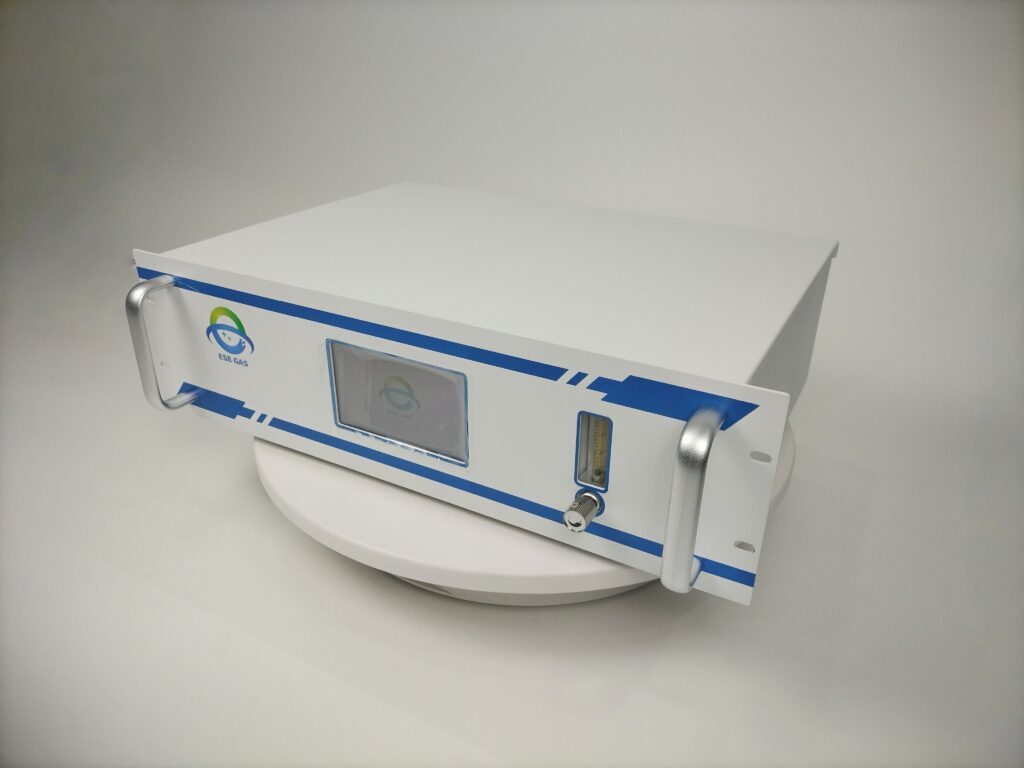
A process gas analyzer provides continuous, real-time measurement of key ripening gases. It tracks ethylene at ppm–ppb levels, along with CO₂ and O₂ concentrations. This allows operators to see the exact ripening condition at any moment. Ethylene is colorless and odorless, so you cannot detect it without instrumentation. Real-time monitoring becomes essential to avoid blind operation. Even small concentration changes can shift ripening speed and product quality.
With continuous data, operators can identify deviations early. Moreover, they can respond before quality loss spreads across the batch. This turns ripening control from delayed reaction into immediate action. Once accurate data is available, the next step is to use it for automated control.
Closed-Loop Control of Ripening Environment
Modern systems use analyzer data to drive closed-loop control. The analyzer connects directly to PLC or control platforms. This enables automatic adjustment of the storage atmosphere. For example, the operators can inject ethylene to trigger ripening when needed; they can activate ventilation to remove excess ethylene; and they can also balance oxygen and carbon dioxide to stabilize respiration.
In industrial ripening rooms, ethylene is typically maintained around 50–200 ppm for uniform results . Maintaining this range requires continuous feedback, not manual checks. This closed-loop approach ensures consistent ripening across all batches. Also, it reduces operator workload and human error. However, controlling one gas alone is not enough. Efficient systems must manage all gases together.
Multi-Gas Analysis = Process Optimization
Advanced process gas analyzers measure multiple gases at the same time. Technologies such as NDIR enable stable and selective detection of CO₂, O₂, and ethylene. This multi-gas visibility improves process understanding. Operators can correlate gas trends with ripening stages. They can predict when fruit will reach target quality. It also supports uniform batch control. Instead of relying on sampling, the system monitors the entire environment continuously. This reduces variability between storage rooms and shipments.
At the same time, automation reduces manual intervention and inspection frequency. The process becomes more stable, repeatable, and scalable. With this level of control in place, the next step is to explore which technologies make it possible in real-world applications.
Which Process Gas Analyzer Technologies Are Used in Fruit Ripening Rooms?

NDIR (Non-Dispersive Infrared)
NDIR is widely used in ripening rooms for CO₂ and ethylene monitoring. It has become a standard solution in industrial gas analysis. The principle is straightforward. Gas molecules absorb infrared light at specific wavelengths. The analyzer measures this absorption to determine concentration. This optical method delivers strong stability over long operating periods. It does not consume the sample gas, which reduces drift and maintenance.
NDIR also supports multi-gas measurement in one system. It can track CO₂, hydrocarbons, and other IR-active gases simultaneously. This is useful in ripening rooms where gas interactions matter. In addition, NDIR performs well in humid and harsh environments. That makes it suitable for cold storage and ripening chambers.
However, some applications demand higher selectivity and faster response. This is where laser-based technologies come into play.
Tunable Diode Laser Absorption Spectroscopy (TDLAS)
TDLAS uses a tunable laser to target a specific gas absorption line. It measures how much light the gas absorbs to calculate concentration. Each analyzer typically focuses on one gas only. This design ensures very high selectivity and avoids cross-interference.
TDLAS is commonly used for O₂, CO₂, or ethylene monitoring in critical control points. It provides ppm to ppb-level sensitivity, which is important for trace detection. The response time is fast, and the measurement is highly precise. It can also perform in-situ measurement without gas extraction. This reduces delay and improves real-time control. Another advantage is low maintenance. The optical design resists contamination and works reliably in demanding environments.
While TDLAS offers high precision, it does not replace multi-gas systems. Instead, it complements them in key measurement points.
Technology Selection Insight (Unique Value)
Choosing the right technology depends on the process objective, not just specifications. For ripening rooms, operators often need multi-gas visibility. NDIR fits this requirement well. It provides stable, continuous monitoring of CO₂ and ethylene in one platform.
For critical control loops or trace detection, TDLAS adds value. It delivers high accuracy and fast response for a single target gas. In practice, many facilities combine both technologies. They use NDIR for overall atmosphere monitoring and TDLAS for precise control points.
The goal is not to choose one technology, but to build a reliable measurement strategy. With the right analyzer setup, operators gain full visibility and control. Next, we will explore how these technologies apply across real fruit supply chain scenarios.
Conclusion
Fruit ripening is, at its core, a gas-controlled biochemical process. Ethylene triggers ripening, while oxygen and carbon dioxide regulate its speed and stability. In industrial environments, even slight gas imbalances can shift the entire process. That is why leading facilities rely on precise gas measurement, not guesswork.
Process gas analyzers provide continuous insight into these key gases. They allow operators to maintain optimal concentrations and avoid harmful deviations. Studies show that controlling ethylene, O₂, and CO₂ directly improves fruit quality and extends storage life . In simple terms, better measurement leads to better outcomes.
If you want to move from basic monitoring to full process control, the next step is clear. The ESEGAS team can provide tailored solutions based on your application, gas targets, and operating conditions. From fruit ripening rooms to cold storage, they help you build a stable, data-driven system that delivers consistent results.
FAQs:
1. Why is ethylene monitoring critical in fruit ripening?
Ethylene is the primary trigger for ripening in many fruits. Even very low concentrations can start the process and accelerate quality changes. Once released, ethylene promotes further production in a chain reaction. This can quickly push fruit from optimal ripeness to overripe. A process gas analyzer allows continuous tracking of ethylene levels. This ensures operators control ripening timing instead of reacting too late.
2. What gases should a process gas analyzer measure in ripening rooms?
A complete ripening control system must monitor three key gases:
- Ethylene (C₂H₄): triggers and accelerates ripening
- Oxygen (O₂): controls respiration rate
- Carbon dioxide (CO₂): slows metabolic activity
These gases interact dynamically. For example, lowering oxygen reduces respiration and delays ripening, while elevated CO₂ suppresses metabolic processes. That is why single-gas monitoring is not enough. Multi-gas analysis is essential for stable control.
3. What is the typical ethylene concentration in industrial ripening rooms?
In commercial ripening chambers, ethylene is usually maintained between 50–200 ppm.
Lower concentrations may fail to trigger uniform ripening. Higher levels can cause uneven quality or over-ripening. A process gas analyzer ensures the concentration stays within this optimal range through continuous measurement and feedback control.
4. How do process gas analyzers improve fruit quality and shelf life?
Process gas analyzers provide real-time data on the storage atmosphere. This enables operators to:
- Maintain optimal gas balance
- Prevent premature ripening
- Ensure uniform batch quality
Controlled atmosphere storage, supported by gas monitoring, can significantly extend shelf life by reducing metabolic activity. In short, better measurement leads to better consistency, longer storage, and less waste.
5. Why is real-time monitoring better than manual sampling?
Manual sampling provides only periodic data. It often misses rapid gas fluctuations. Ethylene can accumulate quickly and spread across storage spaces. Real-time monitoring detects these changes instantly. Operators can respond immediately instead of after quality loss occurs. This shift from delayed response to continuous control is critical in large-scale operations.
6. Which technology is best for fruit ripening gas analysis?
The best technology depends on the application:
- NDIR: Ideal for multi-gas monitoring (CO₂ + ethylene), stable and cost-effective
- TDLAS: Best for single-gas, high-precision measurement (O₂, CO₂, or ethylene)
In practice, many facilities combine both. NDIR handles overall monitoring, while TDLAS manages critical control points. This hybrid approach provides both flexibility and precision.
7. Can process gas analyzers reduce food waste?
Yes, significantly. Poor ripening control often leads to overripe or unsellable products.
Ethylene exposure, even at low levels, can shorten product life and reduce quality. By maintaining optimal gas conditions, analyzers help:
- Extend shelf life
- Reduce spoilage
- Improve inventory planning
This directly lowers waste and improves profitability.
8. Are process gas analyzers suitable for cold storage and transport?
Yes. Modern analyzers are designed for harsh environments, including:
- High humidity (80–95% RH)
- Low temperatures
- Enclosed storage or containers
They are widely used in:
- Controlled atmosphere (CA) storage
- Ripening chambers
- Cold chain logistics
Continuous monitoring ensures fruit remains stable during long-distance transport.
9. What is the biggest mistake in fruit ripening control?
The most common mistake is treating ripening as a single-variable problem. In reality, ripening depends on the balance between ethylene, O₂, and CO₂. Ignoring this interaction leads to unstable results. Successful ripening control requires continuous, multi-gas monitoring and adjustment.