



Geothermal power plants rely heavily on accurate gas monitoring. In the previous article, “Which Processes in Geothermal Power Plants Require Process Gas Analyzers?”, we explored where gas analysis takes place across the plant. Engineers typically install processgas analyzers at the wellhead, the steam separation system, the condenser gas removal unit, and emission monitoring points. Each location provides critical data that supports plant stability and safe operation.
However, monitoring locations tell only part of the story. Engineers must also select the right process gas analyzer technologies for each application. Different analyzers rely on different physical principles to detect gases. Some use infrared absorption, while others rely on laser spectroscopy or electrochemical reactions. Each method offers unique strengths under harsh geothermal conditions.
What Gases Does a Process Gas Analyzer Detect in Geothermal Reservoirs?
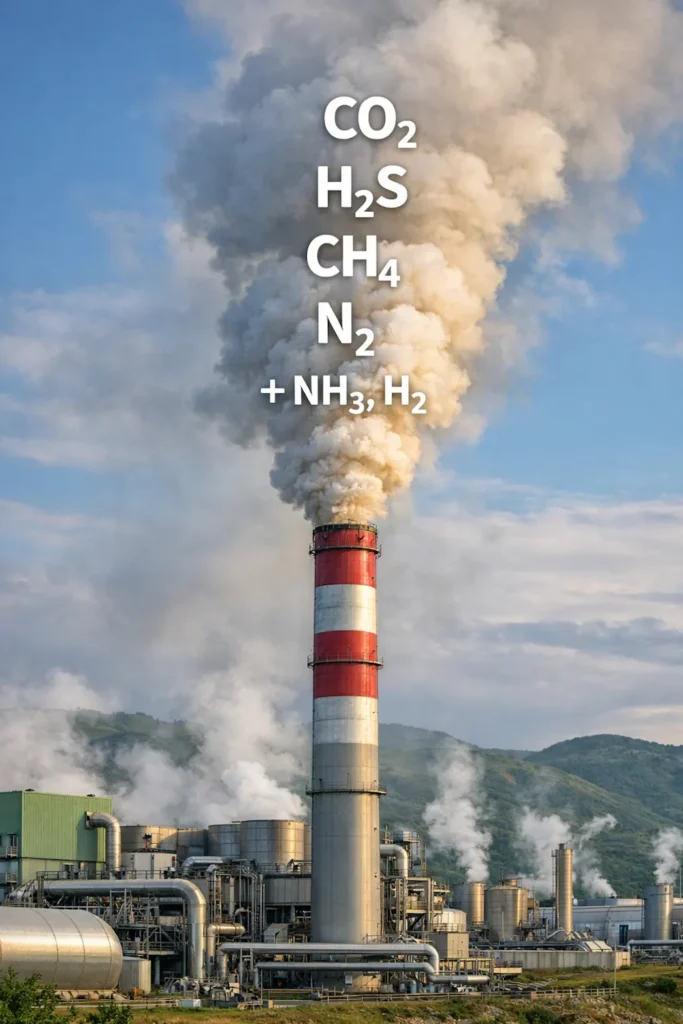
Deep geothermal reservoirs contain more than hot water and steam. They also hold dissolved gases trapped in underground formations. These gases accumulate through geological processes such as magma degassing and rock–fluid reactions. As geothermal fluids circulate through fractures and porous rock, they absorb these gases and carry them upward.
The most common geothermal gases include carbon dioxide (CO₂), hydrogen sulfide (H₂S), methane (CH₄), and nitrogen (N₂). Small amounts of other gases may also appear, such as ammonia or hydrogen. Among them, CO₂ usually dominates the gas mixture, while H₂S often creates the most operational concern.
These gases remain dissolved in geothermal brine under high pressure deep underground. However, conditions change rapidly when the fluid rises through production wells. Pressure and temperature drop during the ascent. As a result, dissolved gases separate from the liquid phase and form non-condensable gases (NCGs) in the steam stream.
Once released, these gases travel with the geothermal steam into surface facilities. They pass through separators, turbines, and condensers along the power generation chain. Even small gas concentrations can influence plant performance. For example, NCG accumulation in the condenser increases back-pressure on the turbine. Higher back-pressure reduces energy conversion efficiency and lowers power output. In addition, corrosive gases such as H₂S may damage pipelines and process equipment over time.
This is why operators closely track gas composition from the earliest production stage. A process gas analyzer provides real-time data on these reservoir gases. The measurements help engineers understand gas behavior and protect critical equipment.
Which Process Gas Analyzer Technologies Are Commonly Used in Geothermal Plants?
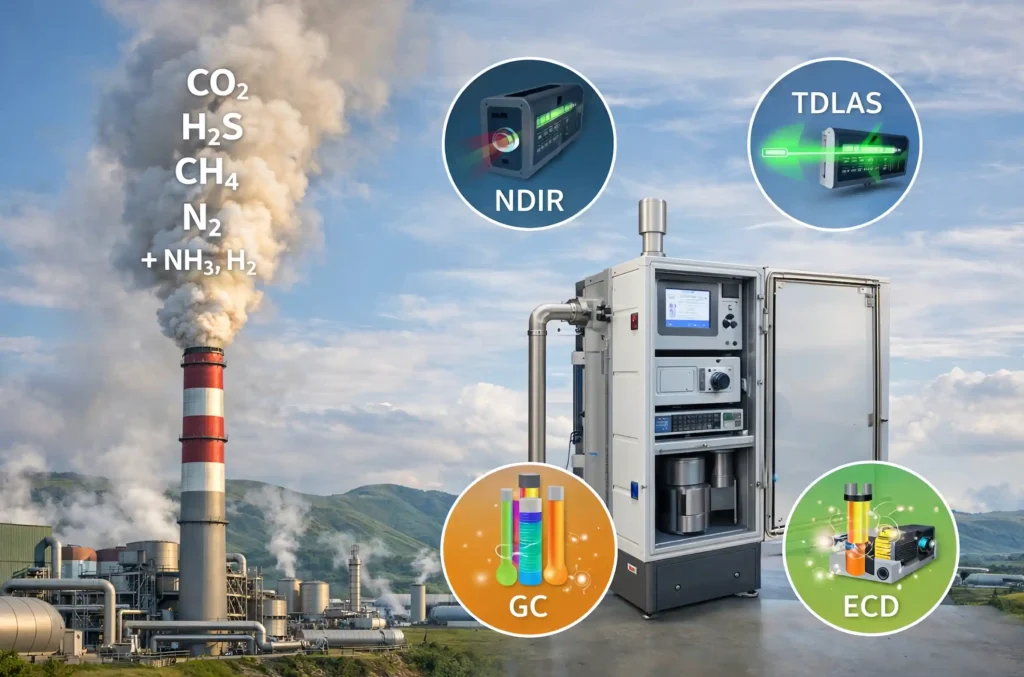
Modern geothermal facilities rely on several process gas analyzer technologies. Each technology uses a different detection principle. Engineers select the analyzer based on gas composition, response speed, and process conditions. In geothermal plants, common targets include CO₂, H₂S, CH₄, O₂, and trace gases. Different analyzers measure these gases at different stages of the production system. Therefore, understanding the core technologies helps engineers choose the right solution.
Tunable Diode Laser Absorption Spectroscopy (TDLAS)
TDLAS analyzers use a narrow-band laser tuned to a specific gas absorption wavelength. When the laser passes through the gas stream, target molecules absorb part of the light. The analyzer calculates gas concentration from the absorbed energy. This technology offers very high sensitivity and fast response. It can detect gases at extremely low concentrations, often in the ppm or ppb range.
In geothermal plants, TDLAS analyzers commonly measure:
- H₂S in steam pipelines or gas removal systems
- CO₂ in process gas streams
- CH₄ in production gas monitoring
- O₂ for air ingress detection
Because the laser interacts directly with the gas stream, TDLAS analyzers provide stable measurements even in harsh environments.
Non-Dispersive Infrared (NDIR)
NDIR analyzers measure gases based on infrared absorption. Many gas molecules absorb infrared radiation at specific wavelengths. The analyzer sends infrared light through the gas sample and measures how much energy is absorbed. Different gases absorb different wavelengths, which allows selective detection.
In geothermal applications, NDIR analyzers typically monitor:
- CO₂ in non-condensable gas streams
- CH₄ in geothermal gas mixtures
- CO in emission monitoring systems
NDIR technology is widely used because it offers good accuracy and relatively simple maintenance. It performs well in continuous industrial monitoring.
Electrochemical Gas Sensors
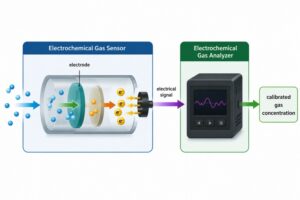
Electrochemical sensors detect gas concentration through chemical reactions inside the sensor cell. When a target gas enters the cell, it reacts with an electrolyte and produces an electrical signal.
The signal strength corresponds to the gas concentration. These sensors are compact and cost-effective. They are often used in portable analyzers or safety monitoring systems.
In geothermal environments, electrochemical sensors commonly measure:
- O₂ for process control and safety monitoring
- H₂S in workplace safety detection
- CO in emission monitoring
However, these sensors usually require periodic replacement because the chemical components gradually degrade.
Gas Chromatography (GC)
Gas chromatography (GC) provides highly detailed gas composition analysis. The instrument separates gas components inside a column before detection. Each gas travels through the column at a different speed. The analyzer identifies gases based on their retention time and detector response.
GC systems can analyze complex geothermal gas mixtures, including:
- CO₂
- CH₄
- H₂S
- N₂
- trace hydrocarbons
Because GC provides high analytical accuracy, engineers often use it for laboratory analysis or periodic calibration checks.
Each process gas analyzer technology offers unique advantages. Some provide fast real-time monitoring, while others deliver high-precision composition analysis. For geothermal plants, selecting the right analyzer depends on process conditions, gas composition, and maintenance requirements.
How Should Engineers Choose the Right Process Gas Analyzer Technologies for Geothermal Applications?
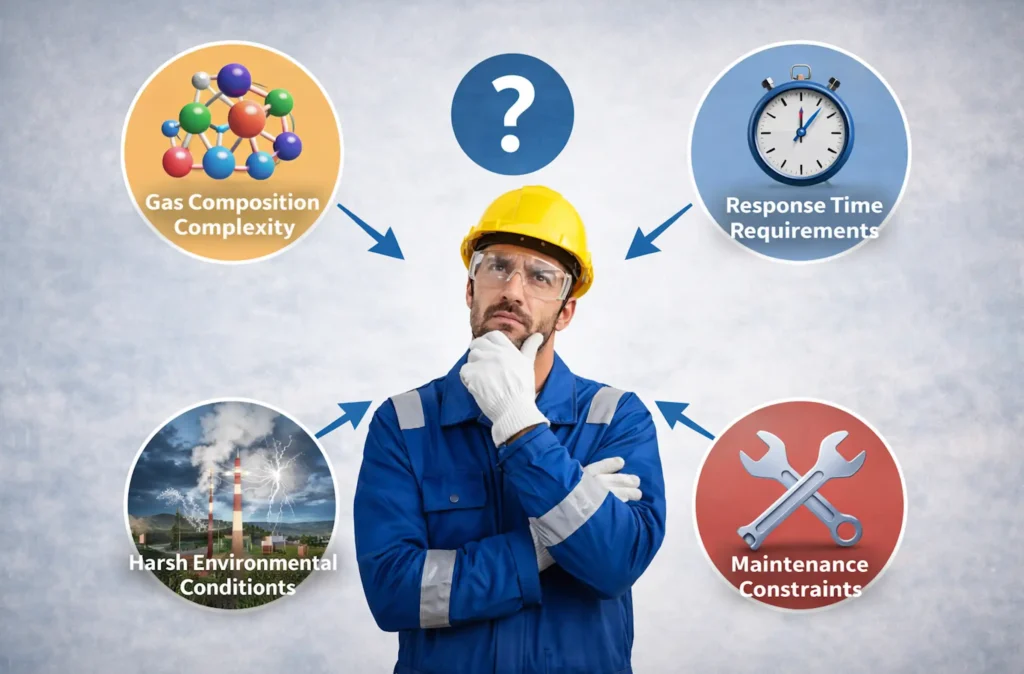
Selecting process gas analyzer technologies for geothermal plants requires more than comparing specifications. Engineers must evaluate how the analyzer performs under real process conditions. Geothermal fluids often contain complex gas mixtures, high humidity, and corrosive compounds. These conditions place strong demands on measurement technology and equipment reliability. In practice, engineers usually focus on four technical factors: gas composition complexity, response time, environmental conditions, and maintenance requirements. Each factor directly affects analyzer performance in geothermal service.
Gas Composition Complexity
The first step is understanding the gas mixture inside the geothermal process. Reservoir gases typically include CO₂, H₂S, CH₄, and nitrogen, along with trace compounds. These gases may vary with reservoir conditions and production rates.
Some analyzers work best for single-gas measurement. Others can analyze multi-component mixtures. For example, laser analyzers provide selective detection for specific gases. Gas chromatography offers detailed composition analysis but usually operates slower. Engineers must match the analyzer technology to the complexity of the gas stream. A mismatch can lead to inaccurate readings or cross-interference between gases.
Response Time Requirements
Process response time is another key selection factor. In dynamic systems such as turbine inlet monitoring, gas concentrations may change quickly. Fast analyzer response helps operators react before process conditions drift out of range. In industrial gas monitoring, many systems aim for response times within seconds to ensure timely detection.
However, not every application requires ultra-fast measurements. For example, laboratory-type analyzers such as gas chromatographs often take several minutes per analysis cycle. Therefore, engineers must balance speed with measurement precision when selecting the analyzer.
Harsh Environmental Conditions
Geothermal facilities operate under challenging environmental conditions. Process gases often contain high humidity, corrosive components, and elevated temperatures. Hydrogen sulfide and carbon dioxide can accelerate corrosion in pipelines and instruments. Because of this, analyzers must withstand aggressive process environments. Optical technologies such as laser-based analyzers often perform well because they avoid direct chemical reactions with the gas.
Engineers also evaluate sampling systems, protective housings, and material compatibility before selecting the analyzer.
Maintenance Constraints
Maintenance requirements strongly influence analyzer selection, especially for remote geothermal plants. Some technologies require frequent calibration, sensor replacement, or sample conditioning. Electrochemical sensors, for example, rely on consumable electrolytes that gradually degrade over time. In contrast, optical analyzers usually provide longer service intervals with fewer replacement parts.
Modern analyzers also include automated calibration and diagnostic functions that simplify maintenance tasks. For plant operators, the goal is simple: reliable measurements with minimal downtime. Choosing the right technology ensures stable gas monitoring across geothermal processes. When properly selected, a process gas analyzer delivers accurate data for reservoir monitoring, turbine protection, and emission control.
Conclusion
Selecting the right process gas analyzer technologies directly affects measurement reliability and plant performance. Engineers must look beyond basic specifications and focus on real operating conditions. Gas composition often changes with reservoir behavior and production load. A suitable analyzer must handle mixed gases without cross-interference. It should also match the required detection range, from trace levels to bulk concentrations. Moreover, the best solution depends on four core factors: gas complexity, response speed, environmental conditions, and maintenance needs. When these factors align, the analyzer becomes a reliable tool for process control and optimization.
If you are planning a geothermal monitoring system, choosing the right technology is a strategic step. ESEGAS provide tailored solutions for harsh industrial environments and multi-gas measurement needs.
FAQs:
1. What are the main types of process gas analyzer technologies?
Common technologies include:
- TDLAS (laser-based analyzers)
- NDIR (infrared analyzers)
- Electrochemical sensors
- Gas chromatography (GC)
Each uses a different detection principle for specific applications.
2. Why is gas chromatography used in geothermal applications?
Gas chromatography provides high-precision analysis of complex gas mixtures. It can separate and quantify multiple gases, making it useful for laboratory analysis and calibration.
3. How do engineers choose the right gas analyzer technology?
Engineers typically evaluate:
- Gas composition complexity
- Required response time
- Environmental conditions
- Maintenance requirements
The best choice balances accuracy, durability, and operational cost.
4. Which technology is best for harsh geothermal environments?
Optical technologies such as TDLAS perform well in high-temperature and corrosive conditions. They avoid direct contact with the gas and offer stable long-term performance.
5. Why is response time important for process gas analyzers?
Fast response allows operators to react quickly to process changes. This is critical for turbine protection and real-time control of gas removal systems.
6. Can one analyzer technology cover all geothermal applications?
Usually not. Most plants use a combination of technologies. Each analyzer is selected based on its specific process location and measurement task.