



Installing a dust monitor correctly on a steel mill chimney matters because regulators and plant operators both depend on accurate data. Dust and particulate matter from steel mill flue gas are strictly regulated, and incorrect readings can lead to compliance failures or costly fines. A poorly positioned monitor might under-report or over-report emissions, skewing environmental reports and undermining trust with stakeholders.

Steel mill flue gas carries a mix of combustion products — including suspended solids, sulfur oxides, and nitrogen oxides — often at high temperature and with complex flow patterns. These conditions make particulate measurement challenging, especially in a highly abrasive, turbulent stack environment.
This guide goes beyond basic installation tips. You’ll learn how to choose the right location on the chimney and prepare for site challenges. By the end, you’ll understand not just where to install a dust monitor, but why each step matters for reliable data, regulatory confidence, and smarter operations.
What Are the Dust Monitor Requirements for Steel Mill Chimney Monitoring?

In a steel mill, a dust monitor plays a central role within the Continuous Emission Monitoring System (CEMS) that tracks particulate matter to meet environmental rules. Steel plants rely on this data to prove they stay within permitted limits and adjust furnace or filtering processes quickly when emissions change. A reliable dust monitor gives plant engineers timely feedback, aiding both regulatory compliance and smarter operational decisions.
You should also know the difference between real-time monitoring and periodic sampling. Real-time systems like CEMS deliver continuous data, helping operators see trends and respond immediately. In contrast, periodic methods take snapshots of particulate levels at set intervals. Both approaches have their place, but steel mills increasingly favor continuous systems because regulators and environmental agencies often require uninterrupted reporting.
That said, installing a dust monitor on a chimney is not straightforward. Industrial stacks present high temperatures, abrasion, and turbulent flow, which can hurt sensor accuracy if not handled properly. The measurement point must capture a representative sample of flue gas, free from flow distortion caused by elbows, fans, or precipitators. Representative sampling ensures the data truly reflects what the stack emits, not just local fluctuations.
Measurement techniques vary, each with unique strengths. Optical and light-scattering methods measure how dust particles affect a light beam and produce near-real-time responses. Other technologies use backscatter lasers or oscillating filters that change mass with particle deposition, which can be calibrated to give quantitative readings. Some methods work better in dry conditions, while others require conditioning of the sampled gas. Operators must match technology to both emission levels and regulatory accuracy requirements.
Understanding these requirements and challenges helps you choose the right dust monitor setup, ensure accurate measurements, and maintain confidence in both compliance reporting and day-to-day plant performance.
What Preparatory Steps Ensure a Dust Monitor Works Correctly on a Steel Mill Chimney?
Before you install a dust monitor on a steel mill chimney, careful preparation makes the difference between reliable data and misleading results. Two areas demand your full attention: assessing the site and ensuring regulatory and safety compliance. These preparatory steps put you in control of both measurement quality and operational risk.
A. Site Assessment & Flow Analysis: Where Should You Place the Dust Monitor?
Selecting the right spot for your dust monitor is critical. You want a location where the flue gas has stable and predictable flow, so the monitor samples gas that truly represents what the stack emits. Standards used in China (e.g., HJ 75-2017 and HJ/T 397-2007) recommend that sampling points be located far enough from elbows, reducers, and valves — typically several times the stack diameter — to avoid turbulence and swirl effects.
If your site cannot fully meet these ideal distances, the alternative is to document deviations carefully and choose a section of the stack where velocity variation is minimized. Some regulators allow a relative root mean square deviation of velocity below a certain threshold (e.g., σr ≤ 0.15) in lieu of strict distance rules.
You also need to consider the flue gas velocity profile. Dust readings depend on how evenly the particles spread across the pipe’s cross-section. Uneven flow can bias measurements, so engineers often use flow modelling or onsite probes to map velocity and decide where the monitor will see a representative sample.
B. Regulatory and Safety Considerations: What Rules Must You Follow?
Installing a dust monitor isn’t just a physical challenge — it also must meet environmental regulatory standards. In China, systems for continuous monitoring of particulate emissions are governed by standards like HJ 75-2017 and related technical guides, which define how CEMS components should perform and be installed.
Compliance means more than just following distances. You must ensure that the sampling point, wiring, and data systems are documented and accessible for auditors and inspections. Many regulations require installation of sampling ports at defined sizes and positions, and they may specify platform access and safety measures for personnel.
Safety is equally important. Chimneys can be high, hot, and confined spaces. Before work begins, secure permits, ensure proper access platforms, and plan for confined space precautions. This includes fall protection, ladders or stair access, and emergency procedures. Putting these safety practices in place protects your team and prevents costly delays.
By thoroughly assessing the site and respecting regulatory and safety requirements, you set the foundation for accurate particulate monitoring. These steps help you avoid common sources of error, ensure data credibility, and build a robust dust monitoring system that environmental officials and plant engineers can trust.
How Should You Mount a Dust Monitor on a Steel Mill Chimney?
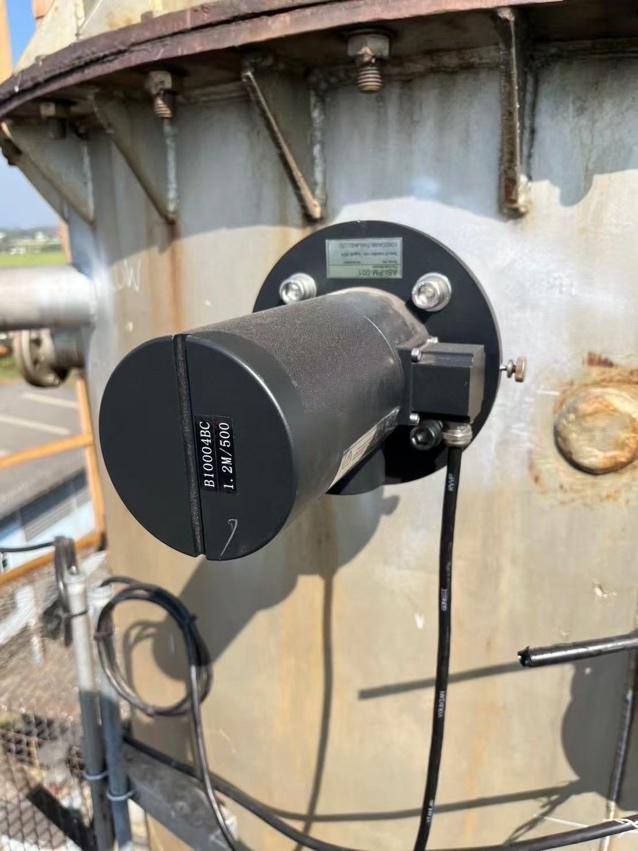
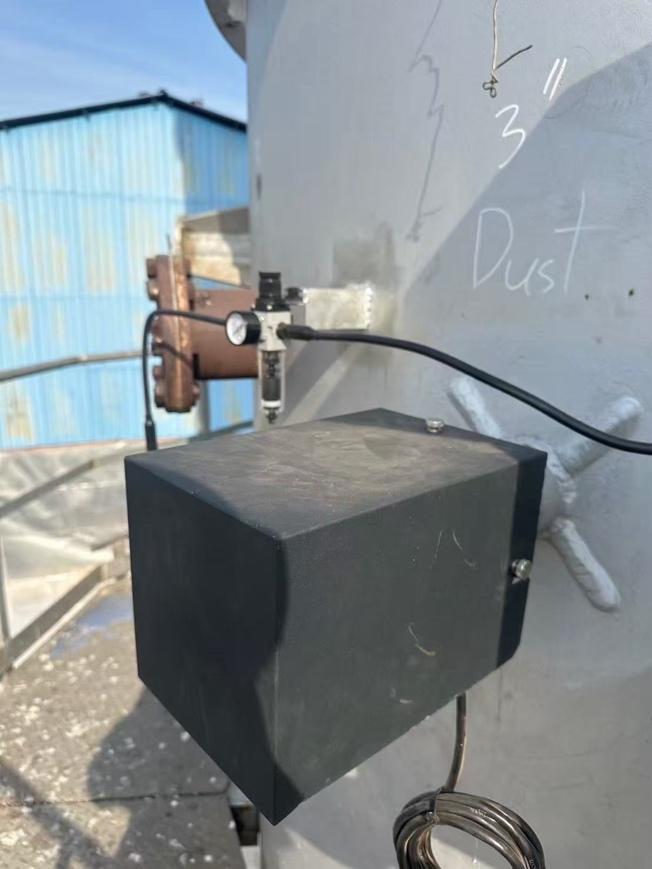
When you install a dust monitor on a steel mill chimney, the goal is clear: place it so it reads reliably under real stack conditions and stays robust during operation. This means paying attention to structural mounting details, environmental protection, and how you route power and data connections. Each of these factors directly affects the monitor’s performance and the credibility of your particulate emission data.
A. Structural Installation, Alignment & Orientation: Where and How to Mount the Sensor
To begin with, choose a section of the chimney with minimal turbulence and steady flow. Avoid locations near elbows, reducers, valves, or abrupt changes in stack diameter, because these features create uneven flow that can bias readings. If possible, install the monitor downstream at least 4× the stack diameter, or upstream at least 2× the diameter to help ensure a representative flow profile. If these distances aren’t achievable, look for a section where the carbon and gas flow is relatively uniform, and where the upstream length is longer than the downstream section, with gas velocity above 5 m/s.
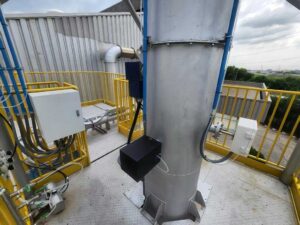
Structural integrity matters as well. For steel chimneys, use proper flange welding or bolted connections that match the stack’s material and operating temperature. On masonry stacks, choose anchor systems that won’t damage the surface yet keep the monitor securely in place above vibration and thermal expansion effects. For optical or light-scattering instruments, align the sensor perpendicular to the gas flow, ensuring the beam pathway sees a stable cross-section of particulate matter.
B. Environmental and Physical Protection: Guarding the Monitor from Harsh Conditions
Dust monitors operate in tough industrial environments. They face temperature extremes, moisture, and vibration, all of which can degrade readings or damage components over time. To protect against these risks, install a protective housing with appropriate IP rating and heat shielding that matches expected stack conditions. This housing should also guard against rain, dust ingress, and corrosive gases.
Where vibration is significant, add isolation mounts between the stack and the sensor body to reduce mechanical stress at the transceiver or detector. Consider adding environmental features like removable covers for maintenance access and purge air connections if excessive dust or condensation could affect optical paths.
C. Cabling, Data, & Power Routing: Making Your Monitor Communicate Reliably
Finally, plan your wiring carefully. Use secure conduit or steel raceways from the dust monitor to the control room to protect cables from heat, abrasion, and rodents. Keep power and signal cables separated where possible to reduce electrical noise. For analog signals such as 4-20 mA loops or digital communications (e.g., RS485), use shielded cables and proper grounding to maintain signal integrity, especially over long runs.
If your system supports redundancy or multiple outputs, incorporate these into your routing plan early to avoid future downtime. This can help the monitor feed data to both plant process control systems and environmental reporting platforms without extra installation work later.
By paying close attention to where and how you mount the dust monitor — from structural fastening to protecting delicate sensor elements and ensuring reliable routing of power and data — you set the stage for accurate emissions measurement that stands up to compliance audits and operational demands.
Conclusion
As we’ve walked through the key steps in choosing a sampling point, mounting a dust monitor, and tying it into broader measurement systems, one idea stands out: precision matters. A correctly installed dust monitor yields credible data that helps your steel mill meet regulatory requirements and understand its emissions with confidence. This matters because regulators demand accurate particulate records, and poor data can lead to compliance setbacks or misinformed process adjustments.
Good installation and integration also empower plant teams to act proactively. With proper siting, structural support, and auxiliary measurements like flow and temperature, your monitor becomes a dependable part of your Continuous Emission Monitoring System. From there, robust data logging and trending help you spot shifts in emissions before they turn into bigger issues — and support both reporting and operational decisions in real time.
To take your installation and monitoring to the next level, don’t hesitate to reach out to a qualified emissions monitoring specialist or dust monitor provider today. A well-integrated, well-maintained dust monitor can be one of your most valuable tools for clean, compliant, and efficient steel production — and a key asset in future-proofing your environmental performance.
FAQs:
1. What is a dust monitor and why is it used on a steel mill chimney?
A dust monitor is a laser-based backscatter particulate instrument used to measure dust loading in combustion exhaust gas streams. It projects a stable laser beam into the flue, and suspended particles reflect a portion of that light back to the detector. The intensity of the backscattered light is proportional to the dust concentration, and the monitor’s internal algorithm converts that signal into a real-time particulate reading.
Steel mills use dust monitors on chimneys to track particulate emissions, support regulatory reporting, and guide decisions on filtration and process performance. Accurate dust data helps plants comply with environmental limits and optimize emission control systems.
2. Where should a dust monitor be located on a steel mill chimney?
Install the dust monitor where flue gas flow is steady and free of turbulence. Typically this means placing the sampling point downstream at least 4× the stack diameter or upstream at 2× the diameter away from elbows, valves, or diameter changes. If these distances aren’t possible, choose a long, stable flow section.
3. Can a dust monitor be installed without avoiding elbows and valves?
It’s best to avoid elbows and valves because they cause turbulence and uneven flow. However, if site constraints exist, select a section with more uniform flow and ensure the upstream pipe length is longer than the downstream length.
4. How critical is proper mounting and alignment of the dust monitor?
Proper mounting and alignment are essential. Ensuring the monitor is fixed securely and aligned perpendicular to gas flow minimizes measurement bias and improves long-term stability. Appropriate flanges and bolts or welds must match the stack material and thermal conditions.
5. Do dust monitors need environmental protection on a steel mill chimney?
Yes, dust monitors must be protected from temperature extremes, moisture, vibration, and abrasive gases. Enclosures with adequate IP ratings, heat shields, and vibration isolation help sustain sensor precision and device longevity.
6. What should facilities consider before installing a dust monitor?
Before installation, assess stack geometry, flow profiles, and regulatory requirements. Also plan access platforms, safety permits, and wiring routes. A clear site evaluation ensures accurate data and reduces installation challenges.